

Image

Pharmacy Department
The Department of Pharmacy at the University of Namur is dedicated to the advancement of knowledge in the field of pharmacology and pharmaceutical research. It organizes training programs covering pharmaceutical sciences, biochemistry, pharmaceutical analysis and medicinal chemistry. It also contributes to the continuing education of pharmacists in collaboration with the Société scientifique des pharmaciens francophones, and hosts the PHARMAFUN alumni association. Finally, it is committed to a training program focused on international openness, the implementation of a quality system and the integration of innovative pedagogies.

How can women be better protected against the risks of thrombosis associated with the contraceptive pill? Researchers from the Department of Pharmacy at UNamur have just developed an innovative prediction model that can estimate the risk of thrombosis associated with taking combined oral contraceptives at an earlier stage. The ultimate goal is to support healthcare professionals in prescribing the right pill for each patient.

Venous thrombosis is one of the most serious complications associated with combined oral contraceptives. While this risk is low overall in the general population, it increases significantly in women with specific genetic mutations, such as Factor V Leiden or the G20210A prothrombin mutation, which affects 5 to 7% of the Caucasian population.
"Most people with genetic mutations that promote coagulation disorders are unaware of this because they are not systematically screened. The actual risk of thrombosis when prescribing birth control pills is therefore underestimated for these patients," explains Laure Morimont, a researcher at the Clinical Pharmacology and Toxicology Research Unit (URPC) and head of this research.
As part of her doctoral research, Laure Morimont—under the supervision of Professor Jonathan Douxfils (Director of the URPC and member of the Department of Pharmacy)—has been working on the development of a blood test to assess the risk of thrombosis associated with taking the contraceptive pill. This test, known as nAPCsr (Normalized Activated Protein C Sensitivity Ratio), measures the degree of resistance to activated protein C, a natural inhibitor of coagulation.
By cross-referencing the nAPCsr of a sample of patients taking oral contraceptives with data on the actual risk of thrombosis from pharmacovigilance studies, Laure Morimont's team was able to develop and validate a robust prediction model demonstrating a significant correlation between the thrombotic risk estimated by the nAPCsr for a given pill and the actual incidence of thrombosis observed in the population.
Based on this model and the established reference thresholds, the nAPCsr can then be used to assess a patient's individual risk profile. The test generates a score ranging from 0 to 10, allowing the patient to be ranked in relation to these reference values and her eligibility for a given contraceptive pill to be assessed. "If the test results remain within the reference standards, the patient is considered eligible for any contraceptive pill and the doctor can safely prescribe the desired one. On the other hand, if her score deviates from these standards, the doctor can carry out a more thorough assessment or refer the patient to a pill considered to be less risky. Ultimately, our goal is to help the medical profession in its choice of prescription," emphasizes Laure Morimont.
Currently available in several hospitals in Wallonia at a cost of approximately €70, the test is currently under discussion with a view to partial or total reimbursement by health insurance companies.
The result of six years of research, the work of the URPC team has just been published in Research and Practice in Thrombosis and Haemostasis (RPTH), a journal of the International Society on Thrombosis and Haemostasis (ISTH), an international learned society specializing in thrombosis and hemostasis.
In this publication, we have further developed the prediction model to make it more robust. Using the clinical data obtained, we demonstrate that it is possible to estimate the risk of thrombosis associated with a contraceptive pill well before the actual incidence data are available. This is an important step that paves the way for earlier assessment of the safety of contraceptive formulas.
This publication will also serve as the basis for efforts underway with the European Medicines Agency to recognize this test as an official biomarker.
At the same time, Laure Morimont and her team are continuing their efforts to raise awareness among general practitioners and gynecologists in Wallonia, with the aim of making the test known to a wider range of patients. The nAPCsr is also set to be used outside Belgium, thanks to a collaboration initiated with a hospital in France.
The main mission of the Clinical Pharmacology and Toxicology Research Unit (URPC) at UNamur is to conduct studies and research aimed at evaluating the efficacy, safety, and clinical impact of drugs, treatments, and medical interventions. It brings together researchers from different departments within the Faculty of Medicine.

Beautiful victory for Margaux Mignolet, a researcher at the Faculty of Medicine's Unité de Recherche en Physiologie Moléculaire (URPhyM), who wins 1st prize in the Belgian inter-university final of the Ma thèse en 180 secondes (MT180) competition. Her research? To better understand the mechanisms of antibodies active in cases of long COVID. The second prize in this national competition was also won by a candidate from Namur. It was Petra Manja, from the Unité de Recherche en biologie des micro-organismes (URBM), Department of Biology, Faculty of Science, and is pursuing a thesis aimed at understanding resistance mechanisms in the bacterium E. coli. Both are also researchers at the NARILIS Institute.

"The world of Dory the antibody" is the popularized title of Margaux Mignolet's thesis. This neuroscience researcher is part of the Unité de Recherche en Physiologie Moléculaire (URPhyM) at the Faculty of Medicine. She works under the supervision of Professor Charles Nicaise and is also a member of the NARILIS Institute. She studies pathogenic autoantibodies in patients with post-acute neurological sequelae of COVID-19.
"Many people still suffer from persistent symptoms after COVID (e.g. memory disorders, fatigue, pain,...). This condition is called long COVID. The mechanism is still unknown. One hypothesis is that patients have antibodies that attack their nervous system, inducing an autoimmune disease. The aim of my thesis is to determine whether patients have these antibodies. This will enable better patient care", explains Margaux Mignolet.
On Wednesday May 21, 2025, she brilliantly succeeded in popularizing her research topic and captivating the audience using clear, simple language, at the national inter-university final of the MT 180 competition. The aim of the competition is to inform the general public about the richness and interest of scientific research, while developing the communication skills of doctoral students. Each participant (doctoral student or doctor who graduated in the previous academic year) presents a clear, concise and convincing three-minute popular presentation in French on his or her thesis. All with the support of a single slide!
And Margaux Mignolet managed to convince the jury, as she won first prize in the competition!
A fine accolade for this enthusiast of the human body and medicine. "I've always been fascinated by how our bodies work, and I've always wanted to understand how diseases work and how to cure them. So I studied biomedical sciences in Namur to be able to work in research," she confides. "I never expected to win this prize! The fourteen other participants presented topics that were each more exciting than the last, and the pitches were really well written. I'm very happy to have won this prize, with Petra by my side, and to have been able to experience this competition alongside Thomas and Petra."
Doctoral students from UNamur shone particularly brightly in this competition, with second prize going to Petra Manja, a microbiology researcher at the Research Unit in Microorganism Biology (URBM) of the Faculty of Science (NARILIS Institute). She is a member of Prof. Régis Hallez's research group. Her thesis aims to understand the persistence mechanisms of the E. coli uropathogenic bacterium.
"Uropathogenic E. coli is one of the bacteria that causes cystitis. Treatment of cystitis is difficult, not least because of its persistence. When the bacteria are treated with antibiotics, the majority of the population dies, except for a small population that goes dormant and thus avoids treatment. Studies have shown that a molecule called alarmone plays a role in this form of persistence. The aim of my research is to find out more about this role. To understand it, I'm interested in the protein that produces alarmone, called SpoT. The idea is to find a regulator of SpoT that will be activated when bacteria are treated with antibiotics. This regulator will in turn activate SpoT which leads to alarmone production and bacterial dormancy," she explains. "I really enjoyed this experience, I learned how to popularize my work to make it accessible to the general public. It's also for them that we do science", she reacts.
Her presentation was entitled: "Dormir pour ne pas mourir".
Thomas Rouma, also a researcher at URBM (Faculty of Science) and the NARILIS Institute, and whose doctoral thesis is co-directed by Professors Eric Muraille and Xavier De Bolle, is studying the protective immune response against lung infections caused by Acinetobacter baumannii in mice.
His presentation was entitled: "How to get rid of a freeloader!"
Congratulations to Margaux, Petra and Thomas, who rose to the challenge of presenting their thesis in 180 seconds!
Each year, the MT180 competition takes place initially in the five universities of the Wallonia-Brussels Federation: UCLouvain, ULB, ULiège, UMONS and UNamur. Each university nominates candidates to take part in the inter-university final. This year, the inter-university final brought together 15 doctoral students, including the 3 candidates from UNamur: Margaux Mignolet, Petra Manja and Thomas Rouma.
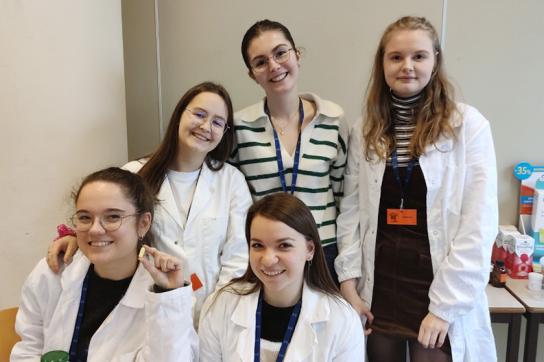
On their own initiative, five masters’ students from the UNamur pharmacy department slipped into the shoes of 'Teddybearologists' as part of the 'Teddy Bear Clinic', an event organised by UCLouvain. They played the role of pharmacists, recommending treatments for children's teddy bears and explaining the role of their future profession.
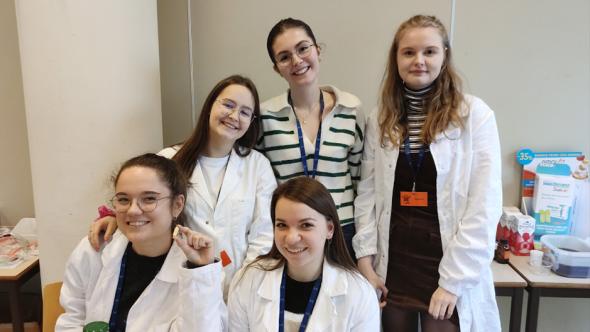
À la Clinique des Nounours (CDN), on soigne des patients un peu particuliers. En effet, c’est un hôpital exclusivement dédié aux peluches« malades ». Les propriétaires, âgés de 4 à 7 ans ont eu la possibilité d’y emmener leurs compagnons afin de les guérir. Les enfants ont donc visité les différents services de la clinique aménagés en stand (chirurgie, dentisterie, pharmacie, kinésithérapie, infirmerie, radiologie, prise de sang, consultation, ambulance, salle d’attente). La CDN a comme objectif de réduire l’angoisse et l’appréhension des enfants lors d’une hospitalisation ou de soins ultérieurs. C’est aussi l’occasion de faire une piqure de rappel en transmettant des messages de prévention et d’éducation à la santé et à l’hygiène : les enfants sont ainsi sensibilisés par exemple à l’hygiène bucco-dentaire par les étudiants en dentisterie, au lavage des mains par les futurs infirmiers mais aussi à une bonne alimentation par les étudiants en diététique.
En participant à la CDN, les étudiantes de l’UNamur ont la possibilité de se familiariseraux contacts avec les enfants. Il s’agit d’un axe de leur formation encadré par des professionnels de la santé qui connaissent bien les enfants (pédopsychiatres, psychologues, pédiatres, infirmiers,etc.).L’objectif ? Leur donner des clés pour adopter leurs pratiques aux réactions et interrogations des enfants.
Alice Tellier, Sophie Richard et Clara Lemaylleux sont venues parler de leur passage à la CDN. Voici leurs témoignages.
« J’ai adoré l’expérience ! J’ai le contact facile avec les enfants parce que je fais du babysitting depuis mes 14 ans, mais leur expliquer le rôle d’un pharmacien, c’est une autre histoire. Suite à ma participation à la CDN, je serai attentive à sensibiliser davantage les enfants sur la prise de médicaments. C’est important de leur rappeler qu’un médicament n’est pas un bonbon et qu’il faut le prendre s’ils veulent guérir ».
Lise Tellier
« Je me suis lancée dans ce projet parce que je voulais montrer aux enfants une image moins effrayante du milieu hospitalier. Nous devions leur expliquer le fonctionnement d’une pharmacie, les différentes formes de médicaments qu’on pouvait y retrouver et leur montrer le processus de fabrication d’une gélule. Je retiens que nous devons veiller à nous adresser aussi aux enfants et pas uniquement à leurs parents ».
Sophie Richard
« C’est chouette de pouvoir initier les plus petits au monde médical qui peut, pour certains, être une source d’angoisse. Les enfants ont souvent peur des dentistes ou des chirurgiens, mais la pharmacie reste pour eux un domaine encore méconnu. J’ai vraiment pris plaisir à leur expliquer l’utilité de mon futur métier en leur montrant qu’un pharmacien n’est pas simplement un vendeur de boites à médicaments. J’ai été étonnée par la maturité de certains enfants qui s’intéressaient à ce qu’on leur montrait et qui posaient parfois des questions très intéressantes ».
Clara Lemaylleux

A team from QUALIblood, a University of Namur spin-off and the Department of Pharmacy has developed a blood test that assesses the risk of developing thrombosis. It is specifically aimed at women wishing to take a contraceptive pill or hormone treatment for the menopause. The development of this test and its availability to healthcare professionals is a world first!

22 000 cas de thromboses surviennent chaque année en Europe suite à l’utilisation de contraceptifs oraux combinés. En Belgique, on en comptabilise approximativement 2 par jour ! L'un des principaux challenges pour les professionnels de la santé est donc d'identifier les femmes à risque.
Le test développé à Namur constitue un nouvel outil permettant de relever ce défi. Depuis plusieurs années, Jonathan Douxfils, CEO de la spin-off QUALIblood et Professeur au Département pharmacie de l’UNamur, travaille sur la mise au point d’un test sanguin dont l’objectif est d’évaluer le risque de thrombose chez les jeunes femmes qui prennent ou qui souhaitent prendre une pilule contraceptive mais également, chez les femmes ménopausées, qui souhaitent démarrer un traitement hormonal de substitution.
Bien que le principe de ce test ait été initié il y a plus de 20 ans, il est rapidement tombé en désuétude suite au manque de standardisation qui menait à une variabilité inacceptable, rendant les résultats ininterprétables. Le Professeur Jonathan Douxfils et son équipe ont donc travaillé sur l’optimisation de la méthode afin de la valider et de rendre les résultats fiables pour répondre aux exigences réglementaires en termes de performances analytiques et cliniques.
Le résultat de cette recherche résulte majoritairement des travaux de Laure Morimont, effectués dans le cadre d’un doctorat en entreprise réalisé à l’aide d’un financement wallon de type Win4doc.
Actuellement, plusieurs lignes directrices offrent un soutien au corps médical, pour adapter la contraception en fonction du profil de la patiente. Cependant, ces stratégies reposent sur des données épidémiologiques et ne permettent pas une évaluation précise du risque de thromboembolie veineuse à l’échelle individuelle. Le test mis au point par les équipes de de QUALIblood et de l’UNamur, qui fournit un résultat précis, fiable et reproductible, permet d’orienter plus précisément la prescription médicale afin de délivrer la bonne contraception à la bonne patiente.
Le résultat, fournit par le test, que l’on appelle nAPCsr (de l’anglais Normalized activated protein C sensitivity ratio), se présente sous la forme d’un score allant de 0 à 10. Au plus le score est élevé, au plus le risque de thrombose est important.
En pratique pour la patiente, il s’agit d’une simple prise de sang sur prescription médicale. Actuellement, le test ne rentre pas dans les critères de remboursement par l’INAMI. Il est donc à charge de la patiente ou du laboratoire pour un prix avoisinant les 50 euros. Néanmoins, un partenariat est en cours avec un acteur majeur du secteur du diagnostic in vitro afin de rendre le test disponible sur une plateforme automatisée et permettre sa commercialisation à l’échelle européenne et puis mondiale. Cela faciliterait son utilisation et son implémentation dans la routine clinique, ce qui permettrait, in fine, de réduire le coût associé voire d’obtenir une intervention des assurance maladies.
Une résistance à la protéine C activée (APC), considérée comme un dysfonctionnement au niveau de la coagulation sanguine, représente un facteur de risque indépendant de thrombose. Bien que plusieurs tests aient été développés, c’est le test de résistance à l’APC basé sur le potentiel de thrombine endogène (ETP) qui s’est montré le plus sensible pour évaluer les changements induits par les contraceptifs oraux combinés sur le système de la coagulation. « Nous sommes parvenus à démontrer les performances analytiques du test de résistance à l’APC basé sur l’ETP ainsi que son intérêt en routine clinique pour prétendre au titre de biomarqueur afin de caractériser le risque de thromboembolie veineuse chez les femmes sous contraception », se réjouit Laure Morimont. Ces résultats probants sont d’ailleurs sélectionnés régulièrement pour présentation orale à congrès internationaux destinés aux hématologues, mais également aux gynécologues.
Le test est déjà utilisé par divers acteurs de l’industrie pharmaceutique dans le cadre du développement de nouveaux contraceptifs. En effet, ce test est un requis règlementaire de l'Agence Européenne des Médicaments dans le cadre de l'évaluation du profil thrombogène des contraceptifs oraux combinés en étude clinique.
Pour permettre son utilisation en clinique, un partenariat s’est développé avec l’hôpital du CHC MontLegia, dans la région de Liège. D’autres collaborations se dessinent avec des laboratoires de biologie clinique de la région namuroise pour que les gynécologues aient accès à cet outil d’aide à la prescription. Des discussions sont également en cours avec un important laboratoire du secteur du diagnostic in vitro afin de déployer le test à plus large échelle.
L’utilisation d’un contraceptif oral combiné n’est pas la seule situation entrainant une coagulopathie d’origine hormonale chez les femmes. Lorsqu’elles arrêtent leur contraception et tombent enceinte, leur risque thrombotique augmente davantage, car la balance hémostatique bascule vers un état prothrombotique afin de limiter les complications hémorragiques lors de l’accouchement. Dans le continuum de la vie des femmes, la ménopause survient, et les symptômes associés peuvent conduire à l’utilisation d’un traitement hormonal, associé lui aussi à un risque accru de thrombose. Toujours en rapport avec les hormones, le cancer du sein hormono-dépendant est l’un des cancers les plus répandus chez la femme et l’utilisation du tamoxifène a été identifié comme un facteur de risque supplémentaire de thrombose chez ces patientes. Dans cette perspective, il y a évidemment un intérêt à utiliser le nAPCsr pour surveiller l’état de coagulabilité de la femme, pendant ces différentes périodes de la vie. Enfin le champ d'application de ce test va au-delà des états prothrombotiques induits par les hormones et pourrait être pertinent dans d'autres pathologies.
Ces tests permettront également de faire des économies en matière de soins de santé. La prise en charge d’une thrombose coûte un peu plus de 30.000 euros par an par patiente, sans compter le risque de récidive qui peut atteindre les 30% à 5 ans. Détecter le risque de maladie thrombotique sur une large population pour ensuite tenter de l'éviter permettrait de réduire les coûts liés à la maladie thrombotique de plusieurs millions d’euros.
On le constate ici, comme souvent, les doctorats en entreprise permettent de belles collaborations et réalisations entre le monde de l’entreprise et celui des universités. La thèse de Laure Morimont, réalisée en synergie entre le Département de pharmacie de l’UNamur et la spin-off QUALIblood en est un bel exemple.
In order to meet today's challenges, the Department of Pharmacy is embarking on a reform whose main thrusts are:
If you would like more information on this reform, we invite you to read our action plan!
