

IRDENa
The Institut de Recherche en Didactiques et Éducation de l'Université de Namur (IRDENa) is made up of researchers from various faculties and departments at the University of Namur. These transversal relationships offer a multidisciplinary approach and aim to amplify synergies between researchers in the world of education and didactics.
Their mission is to foster the emergence of new research objects and methodologies, stemming from a variety of disciplinary anchors.


Plateforme associée | SHS Impulse
La plateforme méthodologique pour les sciences humaines et sociales SHS Impulse propose un soutien adapté aux besoins des chercheurs et renforcer l’excellence en SHS à l’UNamur.

Spotlight
News

Article
-
Faculty of Law
NaDI Institute
Continuing Education: An Opportunity for Universities
Pedagogy
Article
-
Faculty of Law
Faculty Economics Management Communication Politics (EMCP)
Faculty of Education and Training Sciences
NaDI Institute
Institute
IRDENa Institute
Continuing Education: An Opportunity for Universities
Pedagogy
The days when people chose a career once and for all and when experience alone was enough to climb the career ladder seem to be over. Nowadays, lifelong learning has almost become the norm. “There is clearly a trend in this direction, particularly in the context of automation and artificial intelligence, which makes acquiring new skills all the more important,” says Michel Ajzen, a professor in the Management Department at the Faculty of Economics, Management, and Communication at SciencePo, UNamur, and a member of the Namur Digital Institute. “And it’s not a generational issue: whether you’re 30, 40, or 50, this need exists.”

While many companies offer training programs for their employees, it also appears that the “responsibility for employability” has gradually shifted to the workers themselves, who are now expected to take greater control of their careers. “In the past, the boss was seen as responsible for the employee’s development—and even their personal fulfillment—sometimes even beyond the workplace,” notes Michel Ajzen. “But over time, this responsibility for employability has been diluted. ” This trend has been reinforced by new “career scripts,” which are heavily based on mobility. “When I ask students how many employers they think they’ll have in their lifetime, the average answer is six,” the professor continues. “This means that even before entering the workforce, they already have the idea that they’ll move from one employer to another, which can lead them to feel ‘responsible’ for their own careers and thus potentially to pursue training on their own initiative.”
Career Strategies
Getting an education, sure, but in what? And how? As Michel Ajzen explains, this choice depends largely on the “career tactics” adopted by workers. “Depending on their stage of life, they may adopt tactics that are more employment-oriented, with the goal of quickly securing a job to make ends meet,” he explains.
“At other times, they’ll adopt a strategy more focused on employability, with the goal of gradually acquiring the knowledge that will allow them to advance—whether through vertical mobility—within the same company—or horizontal mobility—to another company or a different position. Finally, there’s the ‘meaning’ approach: pursuing training that will lead them to a job that makes them even more eager to get out of bed in the morning…”

Michel Ajzen
Furthermore, training periods are often seen by workers as a breather: an opportunity to step back and “lift their heads up from the handlebars” in what is often a high-pressure workday. This “break” is now governed by various policies. For example, the law of October 3, 2022, guarantees private-sector employees an individual right to training equivalent to 5 days per year for full-time workers. This training may be organized by the employer or left to the employees’ discretion (subject to the employer’s oversight). “However, some companies are not required to guarantee this right to their employees. This is particularly the case for companies with fewer than ten employees,” explains Charlotte Lambert, an associate professor and specialist in labor law. “In labor law, there are also collective bargaining agreements that supplement the law on a sector-by-sector basis and may provide for additional days of training.”
CEP and Time Credit
When an employee wishes to pursue more extensive training—for example, a university certificate program that typically lasts more than five days per year—they can also take advantage of other programs that allow them to maintain all or part of their pay. “Paid educational leave, or CEP—which falls under regional jurisdiction—allows employees to take a recognized training course of at least 32 hours, including initial training,” explains Charlotte Lambert. “The employee retains their pay, while the employer is compensated by the ONEM.”
The other option is “training-related” time credit: this regional program, which exists only in the private sector, allows employees to temporarily reduce or suspend their working hours without affecting the validity of their contract. In this case, the employee receives compensation directly from the ONEM, subject to certain age and seniority requirements. Time credit is also limited to a period of 36 months. “These various programs are not necessarily well known to the public,” comments Charlotte Lambert, “which also explains why many people are discouraged from pursuing training, particularly out of fear of losing their job or having to reduce their working hours and, consequently, their pay.” Furthermore, they are only available to workers with relatively stable employment status (permanent contracts, long-term fixed-term contracts, etc.). “Specific but similar mechanisms exist in the public sector. For the self-employed, however, taking paid leave or using time credits is not an option. They must therefore bear the indirect cost of their training themselves,” the labor law specialist adds.
The Superheroes of the Off-Peak Schedule
Given the need for worker training, universities naturally have a role to play. The “Paysage” decree of November 7, 2013, stipulates that they are authorized to organize continuing education programs accredited by ARES (Academy of Research and Higher Education). “Under the terms of the decree, continuing education does not refer to bachelor’s or master’s degrees, but rather to certificates,” explains Charlotte Lambert. Thus, to avoid any misunderstanding, students should be aware that earning a university certificate is not the same as earning an academic degree and therefore does not confer the same advantages in the job market.
On the other hand, there is indeed the possibility for working professionals to earn a bachelor’s or master’s degree through part-time study, as is the case at the UNamur School of Law. “The unique feature of a bachelor’s degree—and ideally a master’s degree—is that it represents a true fresh start,” emphasizes Mathieu Rolain, academic coordinator of this program and researcher at the Vulnerabilities & Societies (V&S) Center at the Transitions Institute. “Often, it’s a complete career change and sometimes even the fulfillment of a dream: some are 50 years old and are about to begin their bar exam preparation…”. In Block 1 of the Faculty of Law’s part-time program, there are about 50 to 60 enrolled students each year: 10 to 15 of them will graduate in Block 3. “These students are extremely supportive of one another; they share their notes and help each other out when one of them is struggling,” observes the coordinator.

In the same vein, UNamur is committed to tailoring its programs as best as possible to this group. “Many have family responsibilities and sometimes live far from Namur,” continues Mathieu Rolain. “All of our classes are therefore recorded and posted online. We also give them access to staff parking lots and notify them of exam dates well in advance… We try to show them that we support them and understand them. ” Because for these adults with busy professional and personal lives, (re)starting university studies “in evening classes” requires extraordinary discipline and determination, as well as the unconditional support of those around them. “I really admire them a lot,” enthuses Mathieu Rolain. “To me, they’re superheroes. We’ve had medical specialists who came in after their workday, single parents… They’re very unconventional individuals with brilliant backgrounds. They’re also a very demanding group who are always watching your every move—which, for us teachers, is incredibly stimulating.” Because by opening its doors to an experienced audience, the academic world, too, continues to learn.
UNamur, a pioneer in continuing education for teachers
Since the 1980s, the University of Namur has distinguished itself through its expertise in continuing education for teachers, covering both didactic and psychopedagogical aspects.
“It was the Faculty of Philosophy and Letters that initially launched this initiative to offer what were then called ‘refresher courses’ to French teachers,” says Sandrine Biémar, coordinator of the Center for Continuing Education for Teachers at the Faculty of Education and Training Sciences (FaSEF), a professor, and a member of the Institute for Research in Didactics and Education (IRDENa). “ Subsequently, more general training courses on psychopedagogical aspects followed: these were initially organized by the Department of Education and Technology, which has since become FaSEF. Similarly, in the 1990s, the Faculty of Sciences and the Faculty of Economics developed their own centers for continuing teacher education.” These four centers for continuing teacher education are now united under the “Salle des Pros.”
While the decree of June 17, 2021 (Book 6 of the Education Code) formalizes the rights and duties of teaching staff regarding continuing education, this is by no means a new concept for the profession.
“The profession is so complex and subject to so many changes—particularly in curricula and teaching methods—that it is important for teachers to view their career as a continuous process,” insists Sandrine Biémar. “That is why, starting with initial training, we inform students about these opportunities for continuing education.”
The goal is to train “reflective practitioners” capable of questioning their own practices in order to refine and adapt them over time.
“We try to bridge the gap between the world of research and the world of practice: so that we can inform teachers about new studies, but they can also inform us about what’s happening in the field,” the coordinator continues. “The Salle des Pros serves as this space that opens us up to the world.”
The Pros' Room
The Dynamics of Continuing Education for Teachers at the University of Namur: A Crossroads Between Research and Practice!
The Salle des Pros is, above all, a space dedicated to addressing the questions teachers have about their practice. At the intersection of practice and research, it tackles issues that arise in the field through reflection, discussion, and collaborative problem-solving.

Differentiation and Language of Instruction
In addition to the mandatory and free training courses it offers as a “training provider” for teachers, UNamur also offers several certificate programs focused on specific topics. “Teachers voluntarily enroll in these certificate programs, in addition to their mandatory training and outside of their teaching hours, and cover the costs themselves,” explains Sandrine Biémar. Among the topics generating growing interest in the teaching community are differentiated instruction practices. “On a daily basis, teachers are faced with groups of students where each has different needs and learns at different paces,” explains the coordinator. “ Yet there is a whole range of methodologies that allow for these differences to be taken into account, which is a very important issue today, especially with the implementation of the common core curriculum.” Training programs focused on the language of instruction—which are central to combating inequalities—have also expanded significantly. “We make teachers aware that they use language specific to the school setting—‘sit down,’ ‘take out your notebook,’ ‘analyze,’ ‘color in’—and that this language must be made explicit. We need to tell students why we’re having them do this or that.” Finally, AI is, unsurprisingly, one of the new topics in continuing education for teachers, as well as for other audiences (managers, decision-makers, etc.). A new university micro-course on artificial intelligence has been offered since early 2026.
The Benefits of a Flexible/Adapted Schedule
- Identical Degree: The degree awarded is the same as that for the daytime program.
- Recognition of prior learning: Prior learning is recognized and credited.
- Schedule: A calendar and class times tailored to adult learners.
- Access: A campus that’s easily accessible by both train and car.
- Structure: About ten hours of classes per week.
Our staggered/adapted schedules
High School Graduates
- Law
- Economics and Business Administration
- Computer Science
Master's
- Economics and Management
- Education (Sections 4 and 5)
- Computer Science
Specialized Master’s Programs
This article is from the "Issues" section of Omalius magazine, Issue #41 (June 2026).

Article
-
Faculty of Education and Training Sciences
IRDENa Institute
Training reflective, autonomous, and supportive teachers
Pedagogy
Training reflective, autonomous, and supportive teachers
Pedagogy
Since September 2023, the reform of initial teacher training (RFIE) has been profoundly transforming the teaching profession. This year, it is taking a new step forward with the replacement of the former teaching-oriented master's degrees and the agrégation by master's degrees in teaching sections 4 and 5. Led by the Faculty of Education and Training Sciences (FaSEF), in collaboration with the Faculties of Science and EMCP (Economics, Management, Communication, and Political Science), the reform is accompanied by a strengthened partnership with HENALLUX (Namur-Liège-Luxembourg University College).

The RFIE has its roots in a worrying observation: our education system is struggling to fulfill its missions of efficiency and equity. PISA (Programme for International Student Assessment) surveys reveal skill levels below the average for industrialized countries and a chronic inability to compensate for social inequalities. In a European context where education is seen as a lever for the development of "human capital," the Wallonia-Brussels Federation wanted to take action. Inspired by the Lisbon objectives (2009), the reform aims to enhance the status of the teaching profession, strengthen professionalization, and better prepare future teachers for the diversity of school populations. It aims to profoundly transform the culture of training in order to improve the success of all students.
Training reflective and autonomous practitioners
Teacher training is now organized around the ages and needs of students, the skills to be acquired as part of the evolution of the profession, and the Pact for Excellence in Education.
Each program is built around six areas: subject-specific training, communication, training through practice, teaching and pedagogy, humanities and social sciences, and research in education and teaching.
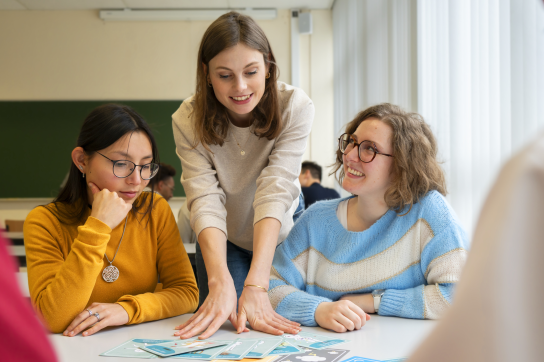
Students therefore learn to combine knowledge, practice, and research to become reflective teachers who are able to evaluate their actions, adjust their methods, and collaborate with their peers.
Diversity and differentiation at the heart of training
One of the pillars of the reform concerns taking student diversity into account. "Not everyone learns in the same way or at the same pace," points out Sandrine Biémar, vice dean of FaSEF. "We want our teachers to be able to diversify their practices without falling into extreme individualization. "
Courses in the psychology of learning, the sociology of education, and differentiated instruction allow us to approach diversity as a source of richness. "Understanding that you yourself have a particular cognitive style," adds Sephora Boucenna, "is already a way of embracing diversity. This leads to offering a variety of learning paths, rather than judging the student as incapable."
For students, this change translates into more appropriate teaching methods and a better understanding of their needs with a view to reducing inequalities. The goal is clear: to avoid repeating a year as a response to difficulties, to train competent citizens, and to contribute to a school system that regains its role as a social ladder.
Internships redesigned to anchor the profession
Another major change is that students now benefit from longer internships that are better supervised and integrated into their training program. "Taking on an intern isn't just about opening up your classroom, observing them, and evaluating them; it's also about being able to support them," emphasizes Sandrine Biémar. That's why UNamur offers a specific certificate for internship supervisors.
This support facilitates the transition to employment. Surveys show that between 30 and 40% of young teachers leave the profession within the first five years. "By strengthening training in and through practice, we want to consolidate their entry into the profession and prevent them from dropping out," she adds.
Stronger collaboration
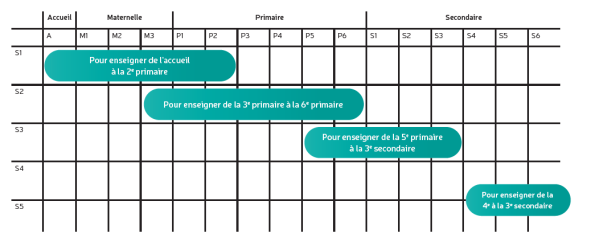
Ensuring continuity between the different levels of education is also a key objective of this reform. "Thanks to the new five-section structure (see illustration)," explains Sandrine Biémar, "a kindergarten teacher has a better understanding of what is at stake in the early years of primary school, and a secondary school teacher can see how learning is built up from the ground up. This consistency helps to avoid disruptions and strengthen continuity in the students' educational journey."
To this end, UNamur is collaborating with HENALLUX within a consortium. "Universities and colleges used to work in parallel," recalls Sandrine Biémar. "Now we are working together to develop curricula and teaching methods. Although UNamur has a long tradition of training teachers for upper secondary school, it is now involved in training teachers from kindergarten to 6th grade."
A coherent educational network
These collaborations extend to continuing education thanks to the Salle des Pros, a UNamur structure that brings together continuing education centers for teachers.
"Through this reform, we are creating a coherent and sustainable network of educational stakeholders," summarizes Sephora Boucenna. "By linking initial training, research, and continuing education, we are laying the foundations for a strong, reflective, and supportive teaching profession."
Discover our training courses
This article is taken from the "Impact" section of Omalius magazine #39 (December 2025).


News
-
Faculty of Sciences
DeFIPP Institute
28 new research projects funded by the FNRS
Award
News
-
Faculty of Sciences
Faculty of Philosophy and Letters
Faculty of Computer Science
Faculty Economics Management Communication Politics (EMCP)
DeFiPP Institute
ILEE Institute
NaDI Institute
Narilis Institute
NaLTT Institute
IRDENa Institute
Institute
28 new research projects funded by the FNRS
Award
The F.R.S.-FNRS has just published the results of its various 2025 calls for proposals. These include the "Credits & Projects" and "WelCHANGE" calls, as well as the "FRIA" (Fund for Research Training in Industry and Agriculture) and "FRESH" (Fund for Research in the Humanities) calls, which aim to support doctoral theses. What are the results for UNamur? Twenty-eight projects have been selected, demonstrating the quality and richness of research at UNamur.

The "Credits & Projects" call for proposals resulted in 12 grants being awarded for ambitious new projects. These include two "equipment" grants, eight "research credits (CDR)" grants, and two "research projects (PDR)" grants, one of which is in collaboration with the ULB. The FRIA call for doctoral research support will fund eleven doctoral scholarships and the FRESH call will fund three.
Two prestigious Scientific Impulse Mandates (MIS) were also obtained. This three-year funding supports young permanent researchers who wish to develop an original and innovative research program by acquiring scientific autonomy within their department.
We would also like to highlight the two projects funded under the "WelCHANGE" call, a funding instrument for research projects with potential societal impact, led by a principal investigator in the humanities and social sciences.
Detailed results
Call for Equipment
- Xavier De Bolle, Narilis Institute, Co-promoter in collaboration with UCLouvain
- Luca Fusaro, NISM Institute
Call for Research Grants (CDR)
- Marc Hennequart, NARILIS Institute
- Nicolas Gillet, NARILIS Institute
- Jean-Yves Matroule, NARILIS Institute
- Patricia Renard, NARILIS Institute
- Francesco Renzi, NARILIS Institute
- Stéphane Vincent, NISM Institute
- Laurence Meurant, NaLTT Institute
- Emma-Louise Silva, NaLTT Institute
Call for Research Projects (PDR)
- Jérémy Dodeigne, Transitions Institute, Co-supervisor in collaboration with ULB
- Luc Henrard, NISM Institute; Co-supervisor: Yoann Olivier, NISM Institute
Fund for Training in Research in Industry and Agriculture (FRIA)
- Emma Bongiovanni - Supervisor: Catherine Michaux, NISM Institute
- Simon Chabot - Supervisor: Carine Michiels, Narilis Institute; Co-supervisor: Anne-Catherine Heuskin, Narilis Institute
- Lee Denis - Supervisor: Muriel Lepère, ILEE Institute
- Maé Desclez - Supervisor: Johan Yans, ILEE Institute; Co-supervisor: Hamed Pourkhorsandi (University of Toulouse)
- Pierre Lombard - Supervisor: Benoît Muylkens, Narilis Institute; Co-supervisor: Damien Coupeau, Narilis Institute
- Amandine Pecquet - Supervisor: Nicolas Gillet, Narilis Institute; Co-supervisor: Damien Coupeau, Narilis Institute
- Kilian Petit - Supervisor: Henri-François Renard, Narilis Institute; Co-supervisor: Xavier De Bolle, Narilis Institute
- Simon Rouxhet - Supervisor: Catherine Michaux, NISM Institute; Co-supervisor: Nicolas Gillet, Narilis Institute
- William Soulié - Supervisor: Yoann Olivier, NISM Institute
- Elisabeth Wanlin - Supervisor: Xavier De Bolle, Narilis Institute
- Laura Willam - Supervisor: Frédérik De Laender, ILEE Institute
Fund for Research in the Humanities (FRESH)
- Louis Droussin - Supervisor: Arthur Borriello, Transitions Institute; Co-supervisor: Vincent Jacquet, Transitions Institute
- Nicolas Larrea Avila - Supervisor: Guilhem Cassan, DeFIPP Institute
- Victor Sluyters – Supervisor: Wafa Hammedi, NADI Institute
- Amandine Leboutte - Co-supervisor: Erika Wauthia (UMons); Co-supervisor: Cédric Vanhoolandt, IRDENa Institute.
Scientific Impulse Mandate (MIS)
- Charlotte Beaudart, Narilis Institute
- Eli Thoré ILEE Institute
WelCHANGE Call
- Nathalie Burnay Transitions Institute, in collaboration with UCLouvain
- Catherine Guirkinger, DeFIPP Institute
Congratulations to all!

Article
-
Faculty of Education and Training Sciences
UNamur School of Social Sciences, Politics and Communication Institute
University and democracy: a living, sometimes threatened, link
What the experts have to say
Democracy
Article
-
Faculty of Education and Training Sciences
Faculty Economics Management Communication Politics (EMCP)
Faculty of Philosophy and Letters
Faculty of Law
UNamur School of Social Sciences, Politics and Communication
Philosophy Department
Institute
ESPHIN Institute
IRDENa Institute
University and democracy: a living, sometimes threatened, link
What the experts have to say
Democracy
Trust of traditional political institutions and elected representatives, rise of authoritarian logics, definition of public services... Democracy today seems to be going through a turbulent zone. What role does the university play in this context? To shed light on this question, we interviewed four researchers from different disciplines: educationalist Sephora Boucenna, philosopher Louis Carré, political scientist Vincent Jacquet and legal scholar Aline Nardi. Their contrasting views sketch out the contours of an issue that is more topical than ever: thinking about and defending the link between university and democracy.

Democracy is by no means a fixed concept. It is the subject of debate, especially today. Louis Carré, Director of the Department of Philosophy and member of the Espace philosophique de Namur (Institut ESPHIN), proposes a three-dimensional definition: a political regime, a state of law and a way of forming society.
.The concept of democracy: between people power and centralization
"Etymologically, democracy is a political regime that consists in giving power to the people," he reminds us. "Our Western democracies today are based on the idea that the people are sovereign, without governing directly. From this arises a tension between ideal democracy and real democracy."Vincent Jacquet, professor in the Department of Social, Political and Communication Sciences and president of the Transitions Institute supports the point: "Democracy is an ideal of citizen self-government, but it is in tension with more centralizing, authoritarian logics. [...] Our political systems are crisscrossed by these different tensions, with both authoritarian logics increasingly present, including in our own country, and logics of participation that are sometimes accompanied by a great deal of hope and disappointment too."
The second pillar according to Louis Carré: the rule of law. Democracy guarantees the fundamental rights of all citizens through the constitution. But here again, beware of paradoxes: "One could indeed imagine laws passed by a majority of representatives or by a referendum, but which contravene fundamental rights" the philosopher stresses. Democracy cannot therefore be summed up by the majority principle alone.
Finally, democracy is also a way of forming society. It is based on real pluralism: diversity of opinions, beliefs and values. "This presupposes the existence of a relatively autonomous public space in the face of the power in place, which at times challenges the decisions taken by the governments that have been elected,"insists Louis Carré.
As such, citizens' distrust of politics is not necessarily a symptom of democratic crisis. It may even be a sign of its vitality, as Vincent Jacquet explains:"The fact that citizens are critical of their government is not necessarily negative because, in a democracy, citizens must be able to control the actions of those in power."

Vincent Jacquet
Training the governors... and the governed
In this context, what is the university's responsibility? Louis Carré begins by reminding us of a simple fact: a large proportion of our elected representatives have passed through university benches. But its teaching mission doesn't stop there. "It's about training enlightened citizens, not just rulers. Universities must offer quality higher education, open to as many people as possible", he asserts.
"Democracy does indeed presuppose citizens capable of debating, reflecting, problematizing issues", adds Sephora Boucenna, Dean of the Faculty of Education and Training Sciences and member of UNamur's Institut de Recherches en Didactiques et Éducation (IRDENA). It's all about training reflective minds, capable of questioning their times.
Training reflective teachers for critical citizens
Universities also train those who, tomorrow, will educate future generations: teachers. And here again, democracy is at stake.
"Our mission is to train reflective teachers who, in turn, will teach their students to think critically"insists Sephora Boucenna. This requires in-depth work on analyzing practices, collective construction and learning to debate, from initial teacher training through to in-service training.

Sephora Boucenna
Producing and disseminating knowledge... in complete independence
In addition to teaching, universities also have a research and social service mission. It produces knowledge that can enlighten public policy, but also question it. This critical function presupposes real independence from politics. "To analyze democratic mechanisms with lucidity, including those that governments put in place, the university must retain its freedom of research and speech," insists Vincent Jacquet.
Louis Carré goes further: "Like the press, the university is a form of counter-power in the public space". He also points out that "there is a confusion between freedom of opinion and academic freedom. Academic knowledge goes through a series of verification, experimentation and discussion procedures within the scientific community. This gives it a robustness that is not that of an opinion, a value, a belief."

Louis Carré
This critical function of the university presupposes strong independence. In Belgium, however, university funding is largely a matter for the political authorities. "Celane must not mean being placed under tutelage", warns Louis Carré. "Conducting critical research that doesn't satisfy short-term sponsors requires independence, including in terms of resources. We need a large number of researchers who can analyze different types of dynamics. The more we cut research funding, as is the case today, the fewer researchers we'll have and therefore the less capacity for independent analysis and diversity of perspectives, insists Vincent Jacquet.
The "Université en colère" movement, recently launched within the universities of the Wallonia-Brussels Federation, intends to denounce the effects of definancement. Its representatives are calling for "guarantee the conditions for the development of an open, independent, quality university accessible to the greatest number. Faced with the social, economic and political challenges of our time, and because other choices for society, and therefore budgets, are possible, it is more essential than ever to strengthen the institutions and players at the heart of knowledge production."
Between vigilance and commitment: a link to be reinvented
Democracy is therefore not limited to elections or institutions. It is based on collective vigilance, carried by citizens, knowledge... and the places where this knowledge is built. In this respect, universities are an essential link in the chain of democratic vitality. Provided it remains independent, accessible and open to society.
"Democracy is not just a matter of institutions. It's about citizens who bring it to life and organize themselves to assert their perspectives at different times", insists Vincent Jacquet. A clear invitation not to remain a spectator, but to participate, with lucidity and exigency, in the construction of a common democratic future.
On the same subject
- Artificial intelligence, a danger for democracy?
An academic year focused on democracy
Find the speech given by Rectrice Annick Castiaux at the 2025-2026 Academic Back-to-School Ceremony.

Cet article est tiré de la rubrique "Le jour où" du magazine Omalius #38 (Septembre 2025).
