

ESPHIN
A transdisciplinary space open to the outside world and designed to stimulate original research, ESPHIN addresses themes developed in its two founding departments: that of Philosophy in the Faculty of Philosophy and Letters and that of Sciences-Philosophies-Society in the Faculty of Science.
In synergy with other entities, researchers also aim for the emergence of new themes in the major fields of philosophy, such as anthropology, ethics, aesthetics, epistemology, logic and metaphysics.
The ESPHIN Institute intends to promote and support philosophical research, both fundamental and applied.


Spotlight
News
News
-
Faculty of Sciences
Science, Philosophy and Society Department ESPHIN Institute
Science & Philosophy in Namur
"Beyond genes": what if we rethought the notion of heredity?
Science, philosophy and society
Philosophy
"Beyond genes": what if we rethought the notion of heredity?
Science, philosophy and society
Philosophy
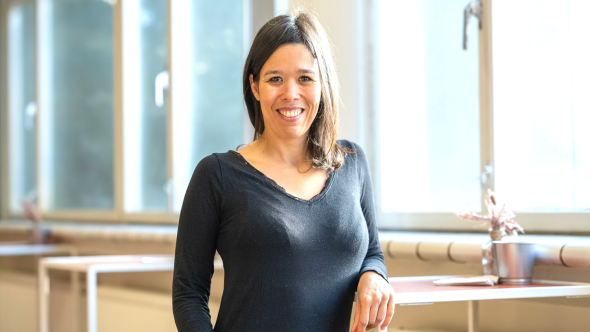
Are we prisoners of our genetic heritage? Can filiation be reduced to genes alone? Can we escape our destiny? Existential questions we all ask ourselves, and to which Gaëlle Pontarotti, lecturer and researcher in the Department of Sciences, Philosophies and Societies at UNamur, sheds new light in her book Par-delà les gènes. Une autre histoire de l'hérédité, published last October by Gallimard.
Until the end of the 20th century, heredity was seen by scientists as a matter of genes and DNA transmission. But in recent decades, research has revealed non-genetic transmissions, helping to explain why children on average resemble their parents more than other individuals in a population. These include epigenetic (changes in gene activity without changing the DNA sequence), microbial, hormonal and behavioral transmissions. Some biologists and philosophers now speak of "extended heredity".
Between fatalism and freedom
"The challenge is to redraw the concept of heredity, going beyond the strictly genetic vision that has prevailed until now", explains Gaëlle Pontarotti. "The aim of my book and my research is to articulate different forms of transmission and to rethink the compatibility between heredity and transgenerational freedom."
For since Greek antiquity, everything suggests that we are locked into a family destiny. But if heredity goes beyond genes, what room for manoeuvre do we have? "The challenge is to find a happy medium between hereditary fatalism and the illusion of omnipotence in the face of our heritage", sums up the researcher.
A paradigm shift with multiple consequences
This new concept overturns our vision of filiation and the status of the individual. We are no longer simply objects determined by causes beyond our control: we are once again actors in what we receive and transmit. It also invites us to reconsider the place of genes in filiation: is the parent fundamentally the one who transmits his or her genetic heritage?
And what if, ultimately, our heritage was also what we chose to make of it?

Cover credit: Éditions Gallimard, book visual Par-delà les gènes.
Discover the book
Par-delà les gènes. Une autre histoire de l'hérédité, by Gaëlle Pontarotti - Gallimard (collection Connaissances)
News
-
Faculty of Sciences
Science, Philosophy and Society Department ESPHIN Institute
Science & Philosophy in Namur
SPiN: a new research center for a new way of thinking about science
Science, philosophy and society
News
-
Faculty of Sciences
Faculty of Philosophy and Letters
Faculty of Computer Science
ESPHIN Institute
Science & Philosophy in Namur
SPiN: a new research center for a new way of thinking about science
Science, philosophy and society
At a time when misinformation, post-truths and conspiracies are undermining confidence in science, UNamur welcomes SPiN (Science & Philosophy in Namur), a new interdisciplinary research center that questions the place of science in society. Founded last September by Olivier Sartenaer, Professor of Philosophy of Science at UNamur, SPiN brings together philosophers and scientists around a common vision: to develop a critical and accessible reflection on science in all its diversity.
.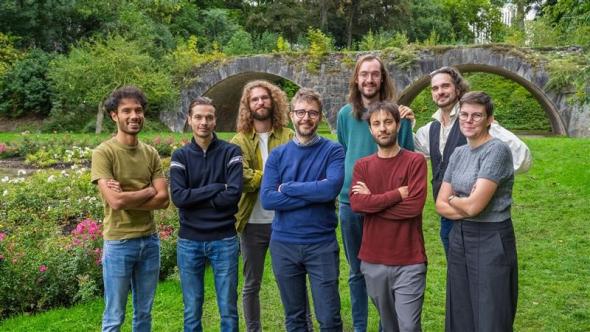
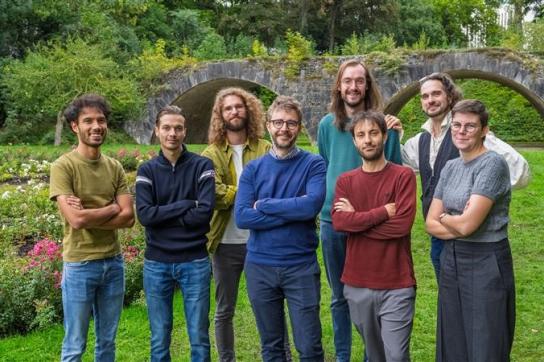
Olivier Sartenaer's team: Doan Vu Duc, Maxime Hilbert, Charly Mobers, Olivier Sartenaer, Louis Halflants, Andrea Roselli, Gauvain Leconte-Chevillard, Eve-Aline Dubois.
While UNamur is distinguished by the presence of a Philosophy of Science department within its Faculty of Science, until now there has been no research center specifically dedicated to the epistemological, ethical, political and metaphysical challenges of science. SPiN fills this gap.

"Several contingent factors enabled the creation of SPiN: the absence of a research structure specifically dedicated to these themes and the almost simultaneous arrival of four young philosophers of science. It's a bit like an alignment of the planets", explains Olivier Sartenaer.
At his side are Juliette Ferry-Danini (Faculty of Computer Science), Thibaut De Meyer (Faculty of Philosophy and Letters) and Gaëlle Pontarotti (Faculty of Science), who form the core of SPiN.
Responding to strong societal demand
SPiN is part of a research dynamic committed to the heart of contemporary debates.
Image

There is a real need for citizens to be enlightened on these issues. It was important for us that a research structure reflect this growing societal demand and host research on these themes.
SPiN researchers explore a wide range of themes, against a backdrop of questioning our relationship to scientific knowledge. These include:
- the relationship between science and pseudoscience;
- reductionism in science;
- genetic determinism and heredity;
- medical ethics and public health (vaccinations, pandemics);
- ethology,
- perspectivism.
This research is carried out by an interdisciplinary team of teacher-researchers, doctoral students and post-docs from the various faculties of UNamur.
An academic meeting place...but also a civic meeting place
SPiN organizes weekly seminars devoted to current research in philosophy of science, as well as seminars linked to more specific themes: health, life sciences, cosmology and theories of emergence and reductionism in the natural sciences.
But SPiN is not limited to the academic sphere: the center intends to take these issues outside the university walls, through events and activities accessible to all. An inaugural event is already planned for next spring on a topical theme: mistrust in science. More info to come!
Find out more about the SPiN research center

Article
-
Faculty of Education and Training Sciences
UNamur School of Social Sciences, Politics and Communication Institute
University and democracy: a living, sometimes threatened, link
What the experts have to say
Democracy
Article
-
Faculty of Education and Training Sciences
Faculty Economics Management Communication Politics (EMCP)
Faculty of Philosophy and Letters
Faculty of Law
Institute
ESPHIN Institute
IRDENa Institute
University and democracy: a living, sometimes threatened, link
What the experts have to say
Democracy
Trust of traditional political institutions and elected representatives, rise of authoritarian logics, definition of public services... Democracy today seems to be going through a turbulent zone. What role does the university play in this context? To shed light on this question, we interviewed four researchers from different disciplines: educationalist Sephora Boucenna, philosopher Louis Carré, political scientist Vincent Jacquet and legal scholar Aline Nardi. Their contrasting views sketch out the contours of an issue that is more topical than ever: thinking about and defending the link between university and democracy.

Democracy is by no means a fixed concept. It is the subject of debate, especially today. Louis Carré, Director of the Department of Philosophy and member of the Espace philosophique de Namur (Institut ESPHIN), proposes a three-dimensional definition: a political regime, a state of law and a way of forming society.
.The concept of democracy: between people power and centralization
"Etymologically, democracy is a political regime that consists in giving power to the people," he reminds us. "Our Western democracies today are based on the idea that the people are sovereign, without governing directly. From this arises a tension between ideal democracy and real democracy."Vincent Jacquet, professor in the Department of Social, Political and Communication Sciences and president of the Transitions Institute supports the point: "Democracy is an ideal of citizen self-government, but it is in tension with more centralizing, authoritarian logics. [...] Our political systems are crisscrossed by these different tensions, with both authoritarian logics increasingly present, including in our own country, and logics of participation that are sometimes accompanied by a great deal of hope and disappointment too."
The second pillar according to Louis Carré: the rule of law. Democracy guarantees the fundamental rights of all citizens through the constitution. But here again, beware of paradoxes: "One could indeed imagine laws passed by a majority of representatives or by a referendum, but which contravene fundamental rights" the philosopher stresses. Democracy cannot therefore be summed up by the majority principle alone.
Finally, democracy is also a way of forming society. It is based on real pluralism: diversity of opinions, beliefs and values. "This presupposes the existence of a relatively autonomous public space in the face of the power in place, which at times challenges the decisions taken by the governments that have been elected,"insists Louis Carré.
As such, citizens' distrust of politics is not necessarily a symptom of democratic crisis. It may even be a sign of its vitality, as Vincent Jacquet explains:"The fact that citizens are critical of their government is not necessarily negative because, in a democracy, citizens must be able to control the actions of those in power."

Vincent Jacquet
Training the governors... and the governed
In this context, what is the university's responsibility? Louis Carré begins by reminding us of a simple fact: a large proportion of our elected representatives have passed through university benches. But its teaching mission doesn't stop there. "It's about training enlightened citizens, not just rulers. Universities must offer quality higher education, open to as many people as possible", he asserts.
"Democracy does indeed presuppose citizens capable of debating, reflecting, problematizing issues", adds Sephora Boucenna, Dean of the Faculty of Education and Training Sciences and member of UNamur's Institut de Recherches en Didactiques et Éducation (IRDENA). It's all about training reflective minds, capable of questioning their times.
Training reflective teachers for critical citizens
Universities also train those who, tomorrow, will educate future generations: teachers. And here again, democracy is at stake.
"Our mission is to train reflective teachers who, in turn, will teach their students to think critically"insists Sephora Boucenna. This requires in-depth work on analyzing practices, collective construction and learning to debate, from initial teacher training through to in-service training.

Sephora Boucenna
Producing and disseminating knowledge... in complete independence
In addition to teaching, universities also have a research and social service mission. It produces knowledge that can enlighten public policy, but also question it. This critical function presupposes real independence from politics. "To analyze democratic mechanisms with lucidity, including those that governments put in place, the university must retain its freedom of research and speech," insists Vincent Jacquet.
Louis Carré goes further: "Like the press, the university is a form of counter-power in the public space". He also points out that "there is a confusion between freedom of opinion and academic freedom. Academic knowledge goes through a series of verification, experimentation and discussion procedures within the scientific community. This gives it a robustness that is not that of an opinion, a value, a belief."

Louis Carré
This critical function of the university presupposes strong independence. In Belgium, however, university funding is largely a matter for the political authorities. "Celane must not mean being placed under tutelage", warns Louis Carré. "Conducting critical research that doesn't satisfy short-term sponsors requires independence, including in terms of resources. We need a large number of researchers who can analyze different types of dynamics. The more we cut research funding, as is the case today, the fewer researchers we'll have and therefore the less capacity for independent analysis and diversity of perspectives, insists Vincent Jacquet.
The "Université en colère" movement, recently launched within the universities of the Wallonia-Brussels Federation, intends to denounce the effects of definancement. Its representatives are calling for "guarantee the conditions for the development of an open, independent, quality university accessible to the greatest number. Faced with the social, economic and political challenges of our time, and because other choices for society, and therefore budgets, are possible, it is more essential than ever to strengthen the institutions and players at the heart of knowledge production."
Between vigilance and commitment: a link to be reinvented
Democracy is therefore not limited to elections or institutions. It is based on collective vigilance, carried by citizens, knowledge... and the places where this knowledge is built. In this respect, universities are an essential link in the chain of democratic vitality. Provided it remains independent, accessible and open to society.
"Democracy is not just a matter of institutions. It's about citizens who bring it to life and organize themselves to assert their perspectives at different times", insists Vincent Jacquet. A clear invitation not to remain a spectator, but to participate, with lucidity and exigency, in the construction of a common democratic future.
On the same subject
- Artificial intelligence, a danger for democracy?
An academic year focused on democracy
Find the speech given by Rectrice Annick Castiaux at the 2025-2026 Academic Back-to-School Ceremony.

Cet article est tiré de la rubrique "Le jour où" du magazine Omalius #38 (Septembre 2025).

News
-
NaLTT Institute
New impetus for the humanities and social sciences at UNamur
Institution
Humanities and Social Sciences
SDG#4 - Quality education
News
-
NaLTT Institute
DeFiPP Institute
ESPHIN Institute
IRDENa Institute
NaDI Institute
PaTHs Institute
Institute
New impetus for the humanities and social sciences at UNamur
Institution
Humanities and Social Sciences
SDG#4 - Quality education
A new platform dedicated to research in the humanities and social sciences (SHS) is being launched at UNamur. The aim? To offer SHS researchers methodological support tailored to their needs and strengthen SHS excellence at UNamur. This platform, SHS Impulse, will provide various services such as financial support for training, consultancy, access to resources, or co-financed software purchases.

Whether it concerns linguistics, economics, politics, sustainable development, law, history, educational sciences, literature or translation, research in the humanities and social sciences is as eclectic as it is rich and essential for tackling society's challenges. Of UNamur's eleven research institutes, seven are directly involved in SHS research. While there is a high degree of complementarity in these areas of research, better pooling of resources, sharing and easier access to certain services, resources and support will help to sustain and strengthen the excellence of SHS research at UNamur. It is with this in mind that the SHS impulse platform has just been created.
Image

We started from the needs of SHS researchers to establish four axes developed within this platform
.
Resources organized around 4 axes
- Axis 1 - Support for the acquisition of databases, documentary resources and software
- Axis 2 - Subsidy for cutting-edge training in the use of specialized methods
- Axis 3 - Funding access to the SMCS "Support en Méthodologie et Calcul Statistique" platform at UCLouvain, thanks to an inter-university partnership.
- Axis 4 - Setting up an SHS space, containing a laboratory for running experiments and shared work tools promoting exchanges between researchers.
Outlook
This initiative, launched in January 2025, addresses the specific challenges faced by SHS researchers. The long-term aim is to sustain and expand the services. "We will also hire a researcher expert in methodological analysis in SHS who will be able to inform innovative methodologies and frame the methodological design of research projects," emphasizes Sandrine Biémar, vice-dean of UNamur's Faculty of Education and Training Sciences, a member of the IRDENA institute and the SHS Impulse management committee. "The wish is also to support networking between SHS researchers at UNamur and to be a lever for setting up interdisciplinary projects," adds Sandrine Biémar.
The platform's management team is made up of representatives of the university's various SHS institutes, and ensures efficient management of resources. The platform's impact will be assessed during its initial phase (2025-2027), enabling strategies for its sustainability and development to be defined.
Agenda
Congress / Colloquium / Conference
-
Faculty of Sciences
ESPHIN Institute
Science & Philosophy in Namur
The Use of Analogy in Understanding Plant Life
Science, Philosophy, and Society
5
2026
12:15
-
6
2026
17:45
Université de Namur, Faculté de Philosophie et Lettres, salle académique - rue Grafé, 1 - 5000 Namur
Contact person
:
Galvao Dario
Conference organized by the SPiN Research Center at the ESPHIN Institute.
A plant does not seem to have much in common with animals. Yet naturalists of the eighteenth and nineteenth centuries attempted to study plants as if they were animals: they set out, for example, to find an equivalent to the circulatory or respiratory systems. Why did they feel the need to resort to analogical reasoning? What results did they obtain? And more generally, what is the value of this type of reasoning?
On the agenda
Tuesday, May 5, 2026
12:15 PM – Welcome and light lunch
1:30 PM – Introductory remarks
Thibault De Meyer (University of Namur): Why Analogy?
2:15 PM – Session 1: Theory and Practice - Cristiana Oghina-Pavie (University of Angers): The analogy of pragmatic knowledge: actions and transactions in 19th-century horticulture and Quentin Hiernaux (FNRS / Free University of Brussels): The plant-animal analogy employed by A.-P. de Candolle’s physiology in addressing the issue of the sensitivity of living beings
3:45 PM – Coffee break
4:15 PM – Plenary Session 1 - Thierry Hoquet (University of Paris Nanterre): Is the plant/animal analogy valid?
5:45 PM – End of the first day
7:00 PM – Conference dinner
Wednesday, May 6, 2026
9:00 AM – Welcome
9:15 AM – Session 2: Relationships and Boundaries of the Living - Dario Galvão (University of Namur): Analogy and the Faculties of the Living: Animal Reason and Plant Sensibility in the Enlightenment and Ugo Batini (University of Poitiers): Understanding Humanity Through Plants: Analogy and the Metaphysics of the Living in Schopenhauer
10:45 AM – Coffee break
11:15 AM – Plenary Lecture 2 – Pascal Duris (University of Bordeaux): Plants as Humans. Analogy in Linnaeus and the Linneans
12:45 PM – Lunch break
2:00 PM – Toward New Disciplines - Vera Staetmanns (Ruhr University Bochum): Do Plants Think? Analogy in the Plant Psychology of Raoul Heinrich Francé (1874–1943) and Matthieu Amat (University of Rouen Normandy): Analogy and Homology: Transfers from the Life Sciences to the Cultural Sciences in the 19th Century
3:30 PM – Coffee break
4:00 PM – Plenary Session 3 - Aliènor Bertrand (CNRS / ENS de Lyon): “Les œufs du vent” and Their Descendants
5:30 PM – Closing of the conference
5:45 PM – End of the day
Contact: Dario Galvao - dario.galvao@unamur.be
ESPHIN is also...
Reflect
Philosophical research aims both to study, in an interdisciplinary way, issues arising from the formal sciences (logic, mathematics), the humanities and nature, and to construct properly philosophical issues in a transdisciplinary space where the contributions of the various human sciences (political, sociological, clinical, etc.) are mobilized.
Debate
ESPHIN also defines itself as a place for debate, sparking encounters (seminars, colloquia, conferences,...) between practitioners and technicians of the above-mentioned sciences and philosophers in order to implement an effective inter- and transdisciplinarity, based on the conjunction of in-depth study of scientific content and high-level philosophical investigation.
Teaching
Parting from the principle that, within a University, teaching and research must be intimately linked, the Institute also makes it its mission to share the fruits of its research activities with Baccalaureate students (from the Faculty of Philosophy and Letters, the Faculty of Science and other Faculties wishing to join ESPHIN) or Master's students (from the Faculty of Science), and to open up some of their activities to them.
While the Institute aims to be in touch with "field" issues, it intends to strongly preserve the specificity of fundamental philosophical approaches integrating rigorous and demanding approaches to the history of philosophy.