Since 1987, the UNamur School of Evening Studies in Economics and Management at the Faculty Economics Management Communication Politics (EMCP) has been offering undergraduate and graduate programs in economics and management on a shift schedule (HD). These programs, held in the evenings and on Saturdays, on an easily accessible campus, enable adults already in the workforce to return to study for a university degree that gives new perspectives to their professional careers.
Organization
Training modalities are called hybrid because they combine presentational and distanciel activities to make life easier for students. Evening studies award the same diplomas as studies carried out in day courses. Only the ways in which skills are acquired differ, thanks to pedagogy adapted to the audience concerned. All our courses are delivered in French.
The originality of the training and the teaching methods designed to suit adults attract nearly 200 students each year to one of the Faculty's 6 evening programs.

Find out more about the UNamur School of Evening Studies in Economics and Management
Spotlight
News
The Master's degree specializing in sustainable development management and economics: a program rooted in contemporary issues
For more than 30 years, the Department of Flexible Scheduling at the Faculty of Economics, Management, Communication, and Political Science (EMCP) at the University of Namur has been helping adults returning to school to acquire new skills. In 2023, the Department launched a brand-new program: a Master's degree specializing in sustainable development management and economics. This one-year program addresses environmental and societal challenges by training professionals to support the ecological and economic transition.

This article is taken from the "Tomorrow Learn" section of the March 2025 issue of Omalius magazine.
The idea for such a program emerged four years ago. At the time, the context was marked by the deterioration of biodiversity and climate change. Jean-Yves Gnabo, professor at the EMCP Faculty, former director of the HD Department (2020-2023) and director of the program, explains: "We took the time to reflect on societal changes and the training needs they generate. It became clear that we needed to support the agents of change, whether they were from the public sector, the private sector, or self-employed. Our off-peak schedule allows us to reach them directly."
Designed to accommodate the constraints of adults returning to education, the program offers evening and Saturday morning classes, combining face-to-face and distance learning. The aim is to enable students to balance their professional and family lives with their studies. In addition, personalized support is provided in the form of practice sessions, individual coaching, and a dedicated academic coordinator. The program gives students the keys to understanding major developments in different areas of the economy, allowing them to adopt more informed and sustainable strategies.
Innovative teaching methods rooted in real-world experience
The Master's degree program stands out for its commitment to combining academic excellence with practical application. From the outset, the program's objective was clear. "We sought to strike a balance between academic rigor and the practical application of knowledge. Our lecturers come from both academia and the field, ensuring a multidimensional approach to the issues addressed," explains Jean-Yves Gnabo.
This commitment is reflected in particular by:
- Hybrid teaching.
- Flipped classrooms (practicing in class and studying at home) and real-life scenarios, encouraging active student involvement.
- A final thesis with original themes.
The thesis is the result of a symbiosis between the field and the academic world. Students can choose from different tracks. Professor Auguste Debroise, who supervises theses, explains: "Students have three options: a field thesis, a research thesis, or an entrepreneurial thesis. The first option involves companies, organizations, or public authorities identifying issues encountered in the field. Once the requests have been made, we submit them to the students, who choose one based on their interests. We believe that this is a great way to offer them direct field experience and access to real data, while addressing issues with more theoretical concepts and an analytical mindset. The second track is more scientific, with a traditional research focus. We therefore offer students who are more inclined towards a scientific approach the opportunity to write their thesis based on works on the subject. Finally, the third option is to give students with an entrepreneurial spirit the opportunity to develop their project or put it into practice if it is already well developed. In this way, they will compare their real-world project with academic tools to see what real needs it meets and to try to take a step back from their entrepreneurial project and thus develop critical and reflective thinking," explains Auguste Debroise.
Similarly, the "Ecological Transition" seminar is a concrete example of the program's approach. "This seminar is based on sharing experiences with high-level speakers. For example, we welcomed Catharina Sikow-Magny, former Director of Ecological Transition at the European Commission," shares Jean-Yves Gnabo. In addition, other enriching initiatives are held as part of the program. This is particularly the case with the "Cross Perspectives" seminar, which reflects a certain transdisciplinarity by exploring economic and environmental issues through the eyes of a sociologist, a philosopher, and a political scientist. Important courses such as "Fundamentals of Environmental Policy" and "Evaluation of Environmental Resources and Policies" are taught by Professor Ludovic Bequet, PhD in Economics.
Finally, the master's program is enriched by a collaboration with the Université du Littoral Côte d'Opale in Boulogne-sur-Mer, which has more than 20 years of experience in teaching economic and ecological transitions. "This partnership allows us to benefit from the expertise of this university, while offering our students a broader view of the issues at stake. We have set up a course-sharing system, where our students have access to targeted teaching provided by its experts, and vice versa," explains Jean-Yves Gnabo.
An evolving program to stay in step with tomorrow's challenges
In light of rapid developments in environmental and economic issues, the Master's program is supported by a monitoring committee comprising academics and practitioners. The role of this board is to constantly monitor developments and adjust the program in line with new issues. "We have put mechanisms in place to ensure that the program remains closely aligned with reality. In addition, the involvement of numerous experts from international organizations, businesses, and academia ensures that the approach is always relevant and up-to-date. We have around twenty speakers, with profiles ranging from Géraldine Thiry, Director of the National Bank of Belgium, to purely academic profiles," says Jean-Yves Gnabo.
With this new program, UNamur is laying the foundations for key training to meet contemporary challenges. The Master's degree in sustainable development management and economics is positioned as a springboard for its students to become agents of change, armed with solid tools and an informed vision of a world in transition. "This program is aimed at those who not only want to understand the challenges of our time, but above all want to respond to them in a concrete way. We train the actors of transition, giving them the means to decipher the changes at work and to act effectively within their organizations. Our challenge today is to gain greater visibility," concludes Jean-Yves Gnabo.
Did you know?
UNamur is internationally renowned in economics and management, particularly in the fields of sustainable development. The internationally recognized research institutes DeFIPP and Transitions study the impact of transition on nature and our societies, using an interdisciplinary approach.
Teaching, research and social facilities
Jean Lemaire's photographs also highlight the spaces that were made available to students and staff. Several shots show the appearance of the auditoriums of the time, already equipped with folding seats, and the practical rooms, such as the microscopy room (image 1) or the physics and chemistry laboratories. The stacks and consultation room of the Belles Lettres library, from which several readers can be seen (image 2), also come into view. Places devoted to moments of relaxation are not forgotten: several views thus immortalize the bar (image 3), the refectory, the billiard room or even the circle room.
This article is taken from the "Tomorrow Learn" section of Omalius magazine #36 (March 2025).
EMCP Faculty: Working together to transform
In September 1961, a few professors and fifteen students inaugurated the Faculty of Economic and Social Sciences at the University of Namur. Later renamed the Faculté des sciences économiques, sociales et de gestion, or FSESG, in over 60 years of existence, it has trained thousands of students who have become experts and decision-makers in key fields: economics, management, communication and political science. In September 2024, it changed its name to EMCP or Faculté Économie Management Communication sciencesPo. A change of name, symbol of a visionary mutation.
This article is taken from the "The day when" section of Omalius magazine for December 2024.
Four major teaching and research disciplines have marked the Faculty's development and become its pillars over the years: economics and political and social sciences first, then management and communication. "In its early days, the Faculty of Economic, Social and Management Sciences, created by Father Camille-Jean Joset, was united around social sciences and economics," recalls Pietro Zidda, Dean of the EMCP Faculty. "Then, the various fields developed. Management took off, enrolments in political science and communications soared. We were careful to maintain a spirit of collaboration between each of our programs". Far from the usual silos, the Faculty today makes it a point of honor for its chosen disciplines to collaborate, question and nurture each other in order to develop the skills of students and researchers so that together they can contribute to the challenges of a society in transition.
Three key missions
The EMCP Faculty is committed to three major missions. The first is to train responsible experts and decision-makers, through rigorous, hands-on teaching that stimulates critical thinking and openness to the world. It also aims to conduct ambitious, interdisciplinary research with a strong scientific impact, feeding into teaching and innovation. Finally, the EMCP Faculty wishes to act as a responsible player in societal development, sharing knowledge and contributing to informed decisions at regional, national and international levels.
It is therefore quite natural that the FSESG has become the EMCP Faculty, a name now incorporating communication and political sciences and reflecting the importance they have acquired in recent years. Four disciplines united to prepare students and researchers in a transdisciplinary way for the challenges of tomorrow.
Collaboration, transdisciplinarity and unity
The spirit of collaboration is firmly rooted at the heart of the Faculty, which strives to develop transdisciplinary approaches to meet the complex challenges of a society in transition. "To meet these challenges, a solution from a single discipline is no longer enough. We need to think more broadly, with an approach that transcends disciplines," explains Anne-Sophie Collard, Vice-Dean of the EMCP Faculty. A sentiment shared by Zora Gilet, a management engineering student: "This new name above all brings coherence to the Faculty's image and visibility for all the courses on offer. It also represents the intra-faculty diversity that we wish to promote at all levels."
This vision is also accompanied by an internal reorganization, with the creation of four thematic schools or schools: UNamur School of Economics (NSE), UNamur School of Management (UNSM), UNamur School of Social Sciences, Politics and Communication and UNamur School of Evening Studies in Economics and Management. These schools aim to strengthen synergy between disciplines, while promoting a pedagogy that integrates cross-disciplinary skills and innovative working methods. Soft skills, for example, are now systematically integrated into projects, to prepare students to respond to societal challenges in a collaborative and creative way. "I think this change helps to concretize and recognize all the large-scale projects that have been set up in recent years," explains Zora. It's an expression of a desire to develop and innovate, which is more than positive today. I consider myself lucky to be able to witness this change and proud to be part of this community."
"EMCP aims to be the catalyst lever for a future where walls are broken down and barriers between disciplines abolished as much as possible, to provide strong solutions to societal problems," concludes Pietro Zidda. This new name therefore goes beyond mere naming: it symbolizes a renewed commitment to transforming the way graduates are trained, giving them the tools they need to provide strong, coherent solutions to major contemporary challenges.
Innovative and conclusive teaching experiments
Within the Faculty, various projects and teaching experiments illustrate this EMCP vision. Examples?
Learning by doing: an approach that offers immersion in concrete projects from the first year, combining knowledge and cross-disciplinary skills to respond to real-life challenges.
Regards croisés: this project invites students and teachers to explore a topical issue from a variety of disciplinary angles, enriched by exchanges with experts in the field at a major final conference.
Dialogue between a dean and ChatGPT
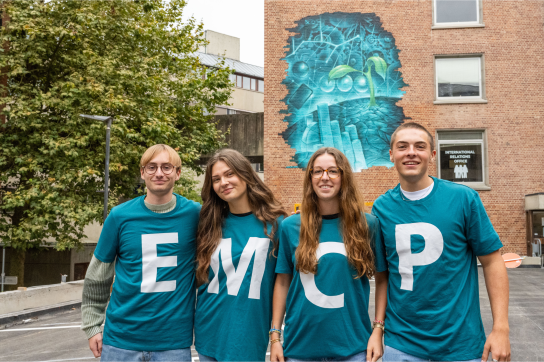
To mark the name change, a fresco was erected on one of the Faculty's facades. The result? A work in shades of blue and green, where the four letters of the faculty are concealed. A young shoot evokes hope and sustainability, patterns of connections symbolize the interactions and complementarities between the various disciplines, a pendulum embodies the balance sought between them...
A little wink, the Dean of Faculty wondered how this fresco would be perceived by an outside audience: "This work is quite original compared to what we usually do. So I asked the artificial intelligence to give me its interpretation. And then, surprise, the answer was bluffing! ChatGPT perfectly identified the meaning and intentions of the project, as if it had read our initial brief", laughs the dean.
The EMCP Circle: students involved in change
Students have also been involved in this transformation, notably through their circles. Thus, the Cercle €co became the Cercle EMCP. "We were contacted by the Dean, who suggested that our Circle should bear the same name as the Faculty, and this seemed to us to be a perfectly natural move. We had many discussions with the dean and the vice-presidents of the Cercle. We put a lot of effort into the name change, but it was an extremely rewarding experience," explains Matthieu Dupuis, President of the Cercle EMCP. "The change may have come as a surprise to some students, but this new name enriches the Faculty's image by enhancing the value of all its courses of study. It embodies strong values and, in my opinion, represents our Faculty better than the old one."
This article is taken from the "The day when" section of Omalius magazine #35 (December 2024).
Training for action: data analysis for the social sector
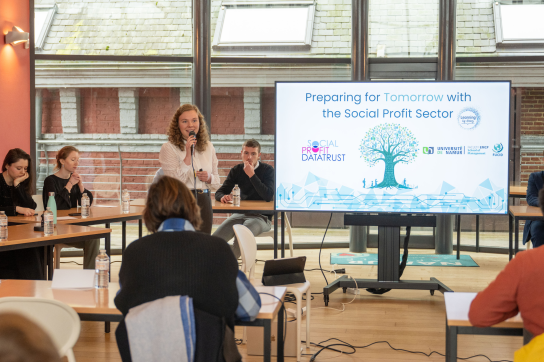
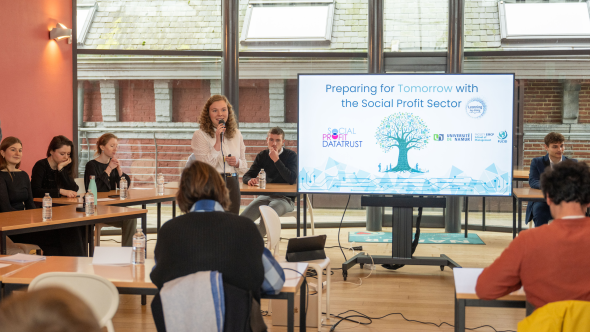
How can data analysis contribute to sustainable development and the social profit sector? This is the challenge answered by students in the Bachelor of Management Engineering program at the Faculty of Economics Management Communication sciencesPo (EMCP) at the University of Namur. On December 12, 2024, they presented their projects at the Namur Stock Exchange, after three months' work on data analyses carried out in collaboration with partners in the social profit sector. They explored themes essential to this sector and our society, as part of the "Data Analytics" course, taught by Claire Deventer in partnership with the King Baudouin Foundation and leading representatives of the social profit sector in Belgium.
The Data Analytics course is an applied course implementing a pedagogy inspired by Service Learning and Learning by Doing. Divided into different teams, the students explored important challenges for the social profit sector and the sustainable development of our society, such as the care offered to the elderly or the match between the training offer and the work sector. These analyses were based, among other things, on data from the Social Profit Data Trust, a platform created by the King Baudouin Foundation in collaboration with representatives of the social profit sector: UNIPSO, Verso, Unisoc, BRUXEO and ConcertES. An immersive setting that enabled students to develop their data analysis skills while reflecting on the positive impacts that their talents in this practice could bring to society.
"The aim of this assignment is to enable students to put themselves in the shoes of real data analysts: analyzing data, proposing concrete solutions and communicating their results in a clear and impactful way, explains Claire Deventer, teacher of the course. "More than technical skills, data analysis also requires managerial, human and ethical skills. Students were coached to think about the impact their data analysis could have on society, and ways of making it as ethical as possible."
Inspired by the Service Learning philosophy where students learn by putting their skills at the service of society, the project spearheaded by Claire Deventer benefited from invaluable pedagogical support from Maxime Giegas, specialist in education for global citizenship and solidarity at the FUCID, Charlotte Sine, technopedagogue at the Faculty of Education and Training Sciences (FaSEF) as well as Benito Giunta, assistant at the Faculty EMCP.
Themes rooted in reality
The students explored three key themes for the social profit sector: an aging society, the changing labor market and the development of the social profit sector.
"Beyond the statistics, there's a human reality, stresses Mathieu de Poorter, economic advisor at UNIPSO and project partner. "As partners in the project, we wanted to see how students, sometimes far removed from our themes, could bring a fresh perspective and make relevant recommendations."
On December 12, 2024, after nearly three months of reflection and work on their theme, the students were able to deliver their analyses and best proposals for solutions. It was at the Namur Stock Exchange that the six student teams presented their work to the project partners, present to debate these important themes:
- Tine Holvoet, policy advisor, entrepreneurship and innovation at Verso Mathieu de Poorter, economic advisor at UnipsoQuentin Pivont, economic advisor at Unipso
- Emilien Leurquin, economic advisor at Unisoc
By highlighting concrete solutions for the social profit sector, this project illustrates how data analytics skills can contribute to and respond to societal and sustainability issues. "Seeing engineering students take an interest in social economy issues is not only inspiring, but essential for building bridges between the academic and professional worlds," enthuses Quentin Pivont.
"The aim of the project was to analyze data to produce a study, a model and come up with concrete solutions", explain Tanguy and Lénaïc, students in management engineering. "We were very challenged, but the teachers supervised us very well." For Ambre and Inès, also management engineering students, this project was a revelation: "This work enabled us to combine our knowledge of programming and analysis with direct feedback from professionals. It enabled us to refine our interests and better define what we like to do. It was a fairly substantial piece of work, but we're really proud of what we're going to propose."
Education for the common good
This innovative pedagogical project demonstrates how data analysis can be a powerful lever for tackling societal challenges and promoting sustainable development. By collaborating with key players in the social profit sector, students not only developed technical and managerial skills, but also became aware of the importance of their role as committed future professionals. This type of initiative perfectly illustrates the University's potential to connect academic knowledge, societal needs and concrete innovations to build a more equitable and sustainable future.
Former UNamur doctoral student featured in The Economist
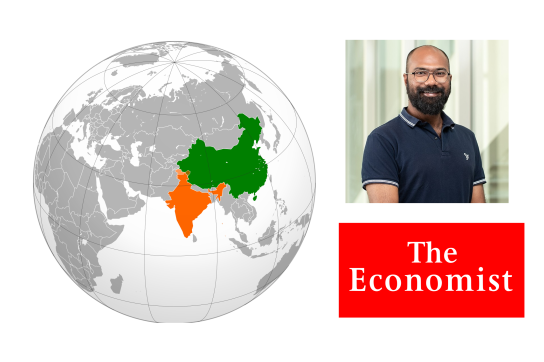
The research of Dr. Nitin Bharti, a former PhD student in the Economics Department of the EMCP Faculty at the University of Namur, is covered in "The Economist", the prestigious international business magazine. The article deals with one of his favorite research themes: understanding the development of education systems and their link with economic growth and long-term inequality.
Nitin Bharti is currently a postdoctoral researcher in the Economics Program of the Division of Social Sciences at New York University Abu Dhabi. He is also coordinator of the World Inequality Lab for South and Southeast Asia. He received his PhD in economics from the Paris School of Economics (PSE) and the University of Namur in September 2022 under the supervision of his promoters, Thomas Piketty (PSE) and Guilhem Cassan (UNamur).
His doctoral thesis at UNamur studied different dimensions of inequality in India:
- Inequality of access to education (covered by the article in the Economist),
- Inequality of income and wealth,
- Inequality of treatment in the face of justice.
For each of these projects, he conducted extraordinary data collection work, searching for new data in historical archives, or using new website data-mining methods to collect large-scale contemporary administrative data. He then exploited this data via cutting-edge econometric methods.
These topics are also at the heart of the themes developed at UNamur, for both teaching and research.
In fact, the DeFiPP Institute has recognized expertise in development economics and environmental economics. Its researchers are very active internationally. Some of DeFiPP's members, for example, have Jim Robinson, Nobel Prize 2024 for his research on the role of institutions in economic development, as a co-author on their articles.
These issues are also at the heart of many of the Economics Department's courses, at both bachelor and master levels. The Department of Economics is keen to offer its students an education that enables them to gain a better understanding of major contemporary societal issues. The Department also has a very long tradition of teaching issues related to the management of environmental resources, inequalities and sustainable development in general.
The Economist | "Bureaucrats, not bridge-builders"
In the article published by The Economist, Nitin Bharti and his co-author Li Yang answer this question: are educational policy choices in India and China at the root of these two countries' economic divergence? The researchers tracked the evolution of education in India and China between 1900 and 2020. According to their study, educational policy is an important and underestimated factor in explaining the trajectories of these countries.
At the beginning of the 20th century, less than 10% of Indian and Chinese children attended school; today, almost all do. But the path to universal education has been remarkably different, and has had profound effects on the development of both countries' economies.
EMCP Faculty | Studies in the Department of Economics
Understand the fundamental dimension of how businesses and our society work, so that you can advise and act as a responsible expert and decision-maker.
The Master's degree specializing in sustainable development management and economics: a program rooted in contemporary issues
For more than 30 years, the Department of Flexible Scheduling at the Faculty of Economics, Management, Communication, and Political Science (EMCP) at the University of Namur has been helping adults returning to school to acquire new skills. In 2023, the Department launched a brand-new program: a Master's degree specializing in sustainable development management and economics. This one-year program addresses environmental and societal challenges by training professionals to support the ecological and economic transition.
This article is taken from the "Tomorrow Learn" section of the March 2025 issue of Omalius magazine.
The idea for such a program emerged four years ago. At the time, the context was marked by the deterioration of biodiversity and climate change. Jean-Yves Gnabo, professor at the EMCP Faculty, former director of the HD Department (2020-2023) and director of the program, explains: "We took the time to reflect on societal changes and the training needs they generate. It became clear that we needed to support the agents of change, whether they were from the public sector, the private sector, or self-employed. Our off-peak schedule allows us to reach them directly."
Designed to accommodate the constraints of adults returning to education, the program offers evening and Saturday morning classes, combining face-to-face and distance learning. The aim is to enable students to balance their professional and family lives with their studies. In addition, personalized support is provided in the form of practice sessions, individual coaching, and a dedicated academic coordinator. The program gives students the keys to understanding major developments in different areas of the economy, allowing them to adopt more informed and sustainable strategies.
Innovative teaching methods rooted in real-world experience
The Master's degree program stands out for its commitment to combining academic excellence with practical application. From the outset, the program's objective was clear. "We sought to strike a balance between academic rigor and the practical application of knowledge. Our lecturers come from both academia and the field, ensuring a multidimensional approach to the issues addressed," explains Jean-Yves Gnabo.
This commitment is reflected in particular by:
- Hybrid teaching.
- Flipped classrooms (practicing in class and studying at home) and real-life scenarios, encouraging active student involvement.
- A final thesis with original themes.
The thesis is the result of a symbiosis between the field and the academic world. Students can choose from different tracks. Professor Auguste Debroise, who supervises theses, explains: "Students have three options: a field thesis, a research thesis, or an entrepreneurial thesis. The first option involves companies, organizations, or public authorities identifying issues encountered in the field. Once the requests have been made, we submit them to the students, who choose one based on their interests. We believe that this is a great way to offer them direct field experience and access to real data, while addressing issues with more theoretical concepts and an analytical mindset. The second track is more scientific, with a traditional research focus. We therefore offer students who are more inclined towards a scientific approach the opportunity to write their thesis based on works on the subject. Finally, the third option is to give students with an entrepreneurial spirit the opportunity to develop their project or put it into practice if it is already well developed. In this way, they will compare their real-world project with academic tools to see what real needs it meets and to try to take a step back from their entrepreneurial project and thus develop critical and reflective thinking," explains Auguste Debroise.
Similarly, the "Ecological Transition" seminar is a concrete example of the program's approach. "This seminar is based on sharing experiences with high-level speakers. For example, we welcomed Catharina Sikow-Magny, former Director of Ecological Transition at the European Commission," shares Jean-Yves Gnabo. In addition, other enriching initiatives are held as part of the program. This is particularly the case with the "Cross Perspectives" seminar, which reflects a certain transdisciplinarity by exploring economic and environmental issues through the eyes of a sociologist, a philosopher, and a political scientist. Important courses such as "Fundamentals of Environmental Policy" and "Evaluation of Environmental Resources and Policies" are taught by Professor Ludovic Bequet, PhD in Economics.
Finally, the master's program is enriched by a collaboration with the Université du Littoral Côte d'Opale in Boulogne-sur-Mer, which has more than 20 years of experience in teaching economic and ecological transitions. "This partnership allows us to benefit from the expertise of this university, while offering our students a broader view of the issues at stake. We have set up a course-sharing system, where our students have access to targeted teaching provided by its experts, and vice versa," explains Jean-Yves Gnabo.
An evolving program to stay in step with tomorrow's challenges
In light of rapid developments in environmental and economic issues, the Master's program is supported by a monitoring committee comprising academics and practitioners. The role of this board is to constantly monitor developments and adjust the program in line with new issues. "We have put mechanisms in place to ensure that the program remains closely aligned with reality. In addition, the involvement of numerous experts from international organizations, businesses, and academia ensures that the approach is always relevant and up-to-date. We have around twenty speakers, with profiles ranging from Géraldine Thiry, Director of the National Bank of Belgium, to purely academic profiles," says Jean-Yves Gnabo.
With this new program, UNamur is laying the foundations for key training to meet contemporary challenges. The Master's degree in sustainable development management and economics is positioned as a springboard for its students to become agents of change, armed with solid tools and an informed vision of a world in transition. "This program is aimed at those who not only want to understand the challenges of our time, but above all want to respond to them in a concrete way. We train the actors of transition, giving them the means to decipher the changes at work and to act effectively within their organizations. Our challenge today is to gain greater visibility," concludes Jean-Yves Gnabo.
Did you know?
UNamur is internationally renowned in economics and management, particularly in the fields of sustainable development. The internationally recognized research institutes DeFIPP and Transitions study the impact of transition on nature and our societies, using an interdisciplinary approach.
Teaching, research and social facilities
Jean Lemaire's photographs also highlight the spaces that were made available to students and staff. Several shots show the appearance of the auditoriums of the time, already equipped with folding seats, and the practical rooms, such as the microscopy room (image 1) or the physics and chemistry laboratories. The stacks and consultation room of the Belles Lettres library, from which several readers can be seen (image 2), also come into view. Places devoted to moments of relaxation are not forgotten: several views thus immortalize the bar (image 3), the refectory, the billiard room or even the circle room.
This article is taken from the "Tomorrow Learn" section of Omalius magazine #36 (March 2025).
EMCP Faculty: Working together to transform
In September 1961, a few professors and fifteen students inaugurated the Faculty of Economic and Social Sciences at the University of Namur. Later renamed the Faculté des sciences économiques, sociales et de gestion, or FSESG, in over 60 years of existence, it has trained thousands of students who have become experts and decision-makers in key fields: economics, management, communication and political science. In September 2024, it changed its name to EMCP or Faculté Économie Management Communication sciencesPo. A change of name, symbol of a visionary mutation.
This article is taken from the "The day when" section of Omalius magazine for December 2024.
Four major teaching and research disciplines have marked the Faculty's development and become its pillars over the years: economics and political and social sciences first, then management and communication. "In its early days, the Faculty of Economic, Social and Management Sciences, created by Father Camille-Jean Joset, was united around social sciences and economics," recalls Pietro Zidda, Dean of the EMCP Faculty. "Then, the various fields developed. Management took off, enrolments in political science and communications soared. We were careful to maintain a spirit of collaboration between each of our programs". Far from the usual silos, the Faculty today makes it a point of honor for its chosen disciplines to collaborate, question and nurture each other in order to develop the skills of students and researchers so that together they can contribute to the challenges of a society in transition.
Three key missions
The EMCP Faculty is committed to three major missions. The first is to train responsible experts and decision-makers, through rigorous, hands-on teaching that stimulates critical thinking and openness to the world. It also aims to conduct ambitious, interdisciplinary research with a strong scientific impact, feeding into teaching and innovation. Finally, the EMCP Faculty wishes to act as a responsible player in societal development, sharing knowledge and contributing to informed decisions at regional, national and international levels.
It is therefore quite natural that the FSESG has become the EMCP Faculty, a name now incorporating communication and political sciences and reflecting the importance they have acquired in recent years. Four disciplines united to prepare students and researchers in a transdisciplinary way for the challenges of tomorrow.
Collaboration, transdisciplinarity and unity
The spirit of collaboration is firmly rooted at the heart of the Faculty, which strives to develop transdisciplinary approaches to meet the complex challenges of a society in transition. "To meet these challenges, a solution from a single discipline is no longer enough. We need to think more broadly, with an approach that transcends disciplines," explains Anne-Sophie Collard, Vice-Dean of the EMCP Faculty. A sentiment shared by Zora Gilet, a management engineering student: "This new name above all brings coherence to the Faculty's image and visibility for all the courses on offer. It also represents the intra-faculty diversity that we wish to promote at all levels."
This vision is also accompanied by an internal reorganization, with the creation of four thematic schools or schools: UNamur School of Economics (NSE), UNamur School of Management (UNSM), UNamur School of Social Sciences, Politics and Communication and UNamur School of Evening Studies in Economics and Management. These schools aim to strengthen synergy between disciplines, while promoting a pedagogy that integrates cross-disciplinary skills and innovative working methods. Soft skills, for example, are now systematically integrated into projects, to prepare students to respond to societal challenges in a collaborative and creative way. "I think this change helps to concretize and recognize all the large-scale projects that have been set up in recent years," explains Zora. It's an expression of a desire to develop and innovate, which is more than positive today. I consider myself lucky to be able to witness this change and proud to be part of this community."
"EMCP aims to be the catalyst lever for a future where walls are broken down and barriers between disciplines abolished as much as possible, to provide strong solutions to societal problems," concludes Pietro Zidda. This new name therefore goes beyond mere naming: it symbolizes a renewed commitment to transforming the way graduates are trained, giving them the tools they need to provide strong, coherent solutions to major contemporary challenges.
Innovative and conclusive teaching experiments
Within the Faculty, various projects and teaching experiments illustrate this EMCP vision. Examples?
Learning by doing: an approach that offers immersion in concrete projects from the first year, combining knowledge and cross-disciplinary skills to respond to real-life challenges.
Regards croisés: this project invites students and teachers to explore a topical issue from a variety of disciplinary angles, enriched by exchanges with experts in the field at a major final conference.
Dialogue between a dean and ChatGPT
To mark the name change, a fresco was erected on one of the Faculty's facades. The result? A work in shades of blue and green, where the four letters of the faculty are concealed. A young shoot evokes hope and sustainability, patterns of connections symbolize the interactions and complementarities between the various disciplines, a pendulum embodies the balance sought between them...
A little wink, the Dean of Faculty wondered how this fresco would be perceived by an outside audience: "This work is quite original compared to what we usually do. So I asked the artificial intelligence to give me its interpretation. And then, surprise, the answer was bluffing! ChatGPT perfectly identified the meaning and intentions of the project, as if it had read our initial brief", laughs the dean.
The EMCP Circle: students involved in change
Students have also been involved in this transformation, notably through their circles. Thus, the Cercle €co became the Cercle EMCP. "We were contacted by the Dean, who suggested that our Circle should bear the same name as the Faculty, and this seemed to us to be a perfectly natural move. We had many discussions with the dean and the vice-presidents of the Cercle. We put a lot of effort into the name change, but it was an extremely rewarding experience," explains Matthieu Dupuis, President of the Cercle EMCP. "The change may have come as a surprise to some students, but this new name enriches the Faculty's image by enhancing the value of all its courses of study. It embodies strong values and, in my opinion, represents our Faculty better than the old one."
This article is taken from the "The day when" section of Omalius magazine #35 (December 2024).
Training for action: data analysis for the social sector
How can data analysis contribute to sustainable development and the social profit sector? This is the challenge answered by students in the Bachelor of Management Engineering program at the Faculty of Economics Management Communication sciencesPo (EMCP) at the University of Namur. On December 12, 2024, they presented their projects at the Namur Stock Exchange, after three months' work on data analyses carried out in collaboration with partners in the social profit sector. They explored themes essential to this sector and our society, as part of the "Data Analytics" course, taught by Claire Deventer in partnership with the King Baudouin Foundation and leading representatives of the social profit sector in Belgium.
The Data Analytics course is an applied course implementing a pedagogy inspired by Service Learning and Learning by Doing. Divided into different teams, the students explored important challenges for the social profit sector and the sustainable development of our society, such as the care offered to the elderly or the match between the training offer and the work sector. These analyses were based, among other things, on data from the Social Profit Data Trust, a platform created by the King Baudouin Foundation in collaboration with representatives of the social profit sector: UNIPSO, Verso, Unisoc, BRUXEO and ConcertES. An immersive setting that enabled students to develop their data analysis skills while reflecting on the positive impacts that their talents in this practice could bring to society.
"The aim of this assignment is to enable students to put themselves in the shoes of real data analysts: analyzing data, proposing concrete solutions and communicating their results in a clear and impactful way, explains Claire Deventer, teacher of the course. "More than technical skills, data analysis also requires managerial, human and ethical skills. Students were coached to think about the impact their data analysis could have on society, and ways of making it as ethical as possible."
Inspired by the Service Learning philosophy where students learn by putting their skills at the service of society, the project spearheaded by Claire Deventer benefited from invaluable pedagogical support from Maxime Giegas, specialist in education for global citizenship and solidarity at the FUCID, Charlotte Sine, technopedagogue at the Faculty of Education and Training Sciences (FaSEF) as well as Benito Giunta, assistant at the Faculty EMCP.
Themes rooted in reality
The students explored three key themes for the social profit sector: an aging society, the changing labor market and the development of the social profit sector.
"Beyond the statistics, there's a human reality, stresses Mathieu de Poorter, economic advisor at UNIPSO and project partner. "As partners in the project, we wanted to see how students, sometimes far removed from our themes, could bring a fresh perspective and make relevant recommendations."
On December 12, 2024, after nearly three months of reflection and work on their theme, the students were able to deliver their analyses and best proposals for solutions. It was at the Namur Stock Exchange that the six student teams presented their work to the project partners, present to debate these important themes:
- Tine Holvoet, policy advisor, entrepreneurship and innovation at Verso Mathieu de Poorter, economic advisor at UnipsoQuentin Pivont, economic advisor at Unipso
- Emilien Leurquin, economic advisor at Unisoc
By highlighting concrete solutions for the social profit sector, this project illustrates how data analytics skills can contribute to and respond to societal and sustainability issues. "Seeing engineering students take an interest in social economy issues is not only inspiring, but essential for building bridges between the academic and professional worlds," enthuses Quentin Pivont.
"The aim of the project was to analyze data to produce a study, a model and come up with concrete solutions", explain Tanguy and Lénaïc, students in management engineering. "We were very challenged, but the teachers supervised us very well." For Ambre and Inès, also management engineering students, this project was a revelation: "This work enabled us to combine our knowledge of programming and analysis with direct feedback from professionals. It enabled us to refine our interests and better define what we like to do. It was a fairly substantial piece of work, but we're really proud of what we're going to propose."
Education for the common good
This innovative pedagogical project demonstrates how data analysis can be a powerful lever for tackling societal challenges and promoting sustainable development. By collaborating with key players in the social profit sector, students not only developed technical and managerial skills, but also became aware of the importance of their role as committed future professionals. This type of initiative perfectly illustrates the University's potential to connect academic knowledge, societal needs and concrete innovations to build a more equitable and sustainable future.
Former UNamur doctoral student featured in The Economist
The research of Dr. Nitin Bharti, a former PhD student in the Economics Department of the EMCP Faculty at the University of Namur, is covered in "The Economist", the prestigious international business magazine. The article deals with one of his favorite research themes: understanding the development of education systems and their link with economic growth and long-term inequality.
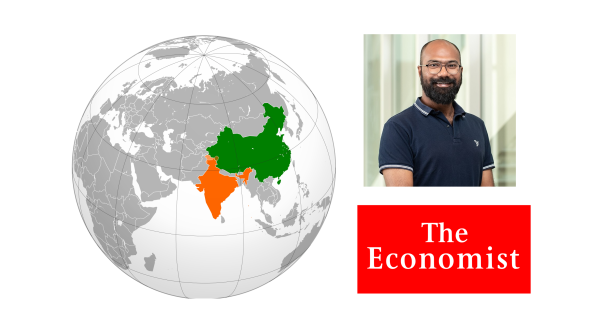
Nitin Bharti is currently a postdoctoral researcher in the Economics Program of the Division of Social Sciences at New York University Abu Dhabi. He is also coordinator of the World Inequality Lab for South and Southeast Asia. He received his PhD in economics from the Paris School of Economics (PSE) and the University of Namur in September 2022 under the supervision of his promoters, Thomas Piketty (PSE) and Guilhem Cassan (UNamur).
His doctoral thesis at UNamur studied different dimensions of inequality in India:
- Inequality of access to education (covered by the article in the Economist),
- Inequality of income and wealth,
- Inequality of treatment in the face of justice.
For each of these projects, he conducted extraordinary data collection work, searching for new data in historical archives, or using new website data-mining methods to collect large-scale contemporary administrative data. He then exploited this data via cutting-edge econometric methods.
These topics are also at the heart of the themes developed at UNamur, for both teaching and research.
In fact, the DeFiPP Institute has recognized expertise in development economics and environmental economics. Its researchers are very active internationally. Some of DeFiPP's members, for example, have Jim Robinson, Nobel Prize 2024 for his research on the role of institutions in economic development, as a co-author on their articles.
These issues are also at the heart of many of the Economics Department's courses, at both bachelor and master levels. The Department of Economics is keen to offer its students an education that enables them to gain a better understanding of major contemporary societal issues. The Department also has a very long tradition of teaching issues related to the management of environmental resources, inequalities and sustainable development in general.
The Economist | "Bureaucrats, not bridge-builders"
In the article published by The Economist, Nitin Bharti and his co-author Li Yang answer this question: are educational policy choices in India and China at the root of these two countries' economic divergence? The researchers tracked the evolution of education in India and China between 1900 and 2020. According to their study, educational policy is an important and underestimated factor in explaining the trajectories of these countries.
At the beginning of the 20th century, less than 10% of Indian and Chinese children attended school; today, almost all do. But the path to universal education has been remarkably different, and has had profound effects on the development of both countries' economies.
EMCP Faculty | Studies in the Department of Economics
Understand the fundamental dimension of how businesses and our society work, so that you can advise and act as a responsible expert and decision-maker.