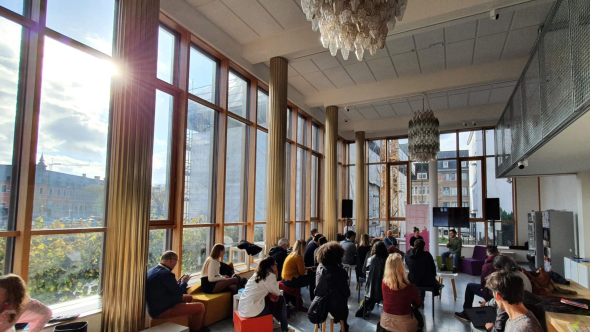
Is creativity an essential skill for the future? New programs are being added to the curriculum starting this fall!
Management
Communication
Created on
20 Mar 2026
Share this article
Experts highlight creativity as an essential skill for tomorrow’s decision-makers in an era of widespread AI adoption. At the same time, the cultural and creative industries represent a rapidly growing sector. To keep pace with these developments, two new tracks will be introduced into the Information and Communication and Management Engineering programs starting next fall. Focus on the expected changes in the Faculty of Economics, Management, Communication, and Political Science (EMCP).
Starting in their bachelor’s program, students in the Management and Information and Communication Engineering track have the opportunity to tailor their degree to a specialization rooted in market needs. This is a unique feature of the Namur program that allows students to remain versatile while avoiding the pitfall of overly specialized profiles. “It’s really a matter of adding a specific focus to the bachelor’s degree, which remains the same regardless of the track chosen,” explain Anthony Simonofski and Fanny Barnabé, professors and directors of the bachelor’s programs in Management Engineering and Information and Communication, respectively.
In this context, two new tracks will be added to these two bachelor’s programs starting this fall: “Creative Technologies” in Management Engineering and “Cultural and Creative Industries” in Information and Communication.
Understanding and Experimenting with Creative Technologies
“For the management engineering program, we’ve traditionally had two bachelor’s tracks: one in information management, focused on IT development, and one in environmental and life sciences, focused on science and sustainability,” explains Anthony Simonofski. Created in collaboration with the Information and Communication program and the School of Computer Science, the “Creative Technologies” track enriches existing programs by offering students the opportunity to imagine and experiment with creative uses of technology in a responsible manner, within a context marked by numerous societal challenges.
Image
The digital and sustainable transition presents organizations with as many challenges as it does opportunities. To innovate and develop new solutions, it is essential to cultivate creative thinking, especially in the age of generative AI.
Anthony SimonofskiProfessor and Director of the Bachelor's Program in Management Engineering
What can students expect from the courses? “Some will focus on new uses of technology, understanding the digital and sustainable transitions, and new creative technologies, such as generative AI, immersive technologies (XR), and video game technologies, among others,” says Anthony Simonofski.
Building connections with Namur’s creative community
As for the Bachelor’s degree in Information and Communication, the plan is to revamp the existing “Culture and Audiovisual” track, which will be renamed “Cultural and Creative Industries” starting this fall. “Alongside the more traditional tracks of ‘Journalism and News Media’ and ‘Organizational Communication,’ this overhaul aims to forge stronger ties with the cultural and creative industries (CCI) sector, which is a highly dynamic sector currently undergoing restructuring. Furthermore, the Namur ecosystem is highly stimulating, featuring events such as the KIKK festival or the FIFF, networks of stakeholders like wake!, and institutions dedicated to popularizing or mediating science and culture such as the Pavillon, the Confluent des savoirs, the Medialab, and others,” explains Fanny Barnabé.
Image
A unique opportunity for students to gain hands-on experience in the cultural and creative sectors during their studies, before entering the workforce.
Fanny BarnabéProfessor and Director of the Bachelor's Program in Information and Communication
While the two programs differ in terms of student profiles and career opportunities, joint courses will be offered to help students integrate into this ecosystem and explore management issues in the creative industries.
UNamur at the heart of digital creativity in Wallonia
The collaboration between UNamur and the cultural and creative industries sector is particularly evident through the wake! by Digital Wallonia label, which aims to bring together Walloon players in the field of digital creativity from a variety of sectors: universities, research centers, creative hubs, festivals, companies, artists, investment funds, and more. UNamur was quickly among the first to contribute to this momentum.
These new programs will also facilitate communication between the cultural industries and future professionals: “The need for academic research and training aligned with the needs of the digital creative industries sector is paramount,” explains Delphine Jenart, wake! coordinator for KIKK. “We do indeed need a new generation of experts at the intersection of communication and creative technologies who understand the sector’s challenges regarding innovation and creativity and can formulate strategies.”
These connections can take the form of guest lectures by professionals in the classroom, as well as internship opportunities or thesis projects.