The University of Namur is asserting itself as a key player in Artificial Intelligence (AI) by integrating this technology into its teaching programs, conducting cutting-edge research on the subject and placing its expertise at the service of society.

Informatique études

The objectives

Informatique études

Teaching

Train students to use AI critically, responsibly and ethically.

Research

Stimulate innovation through transdisciplinary research projects.

Service to society

Accompany public and private players as they face the challenges of this technological revolution.

A global approach to AI

UNamur integrates artificial intelligence at the heart of its missions -research, teaching and service to society- to train students in its critical and responsible use, develop innovative and interdisciplinary research, and put its expertise at the service of societal issues. This all-encompassing approach enables the university to play a leading role in the evolution and ethics of AI.

Spotlight

News

All news

Agenda

All events
Image
Informatique études

Structure and governance: the AI Council

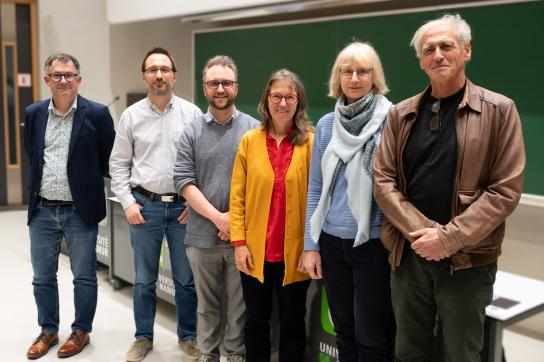
Artificial intelligence (AI) impacts the university's three missions (teaching, research and service), but also its internal operations. The University of Namur intends to seize the opportunities offered by this new milestone in digital transformation, while maintaining a critical and informed eye on these opportunities. To this end, it is setting up a scientific committee to support the "AI" transformation: the AI Council (CIA).

Meet the key players in AI

More portraits
Typically, when conducting research, ChatGPT facilitates the creation of an initial state of the art. The first limitation is that it can only reproduce what it already knows, in other words, the knowledge available at the time it collected this information. Nor can we take what ChatGPT says at face value: it requires a critical eye on the part of the student. The fact that it presents itself as a conversational tool also gives a different perspective on the answers it provides: it feels like you are actually talking to someone, when in fact its response is nothing more than a sequence of words. So the sequence could be different and the resulting text could say the exact opposite.
Laurent Schumacher
Professor at the Faculty of Computer Science and researcher at the NaDI Institute
See content
The world of AI is currently based on a reactive intelligence system. I am trying to implement deliberative intelligence. One of the major limitations of most current AI systems is that they learn to solve a single task based on millions of examples. That is not intelligence. Having segmented knowledge is absurd! Intelligence is about solving new problems and adapting based on the knowledge you already have.
Katrien Beuls
Professor at the Faculty of Computer Science and researcher at the NaDI Institute
See content
Personally, I am a big believer in the idea of mentoring in education, in one-to-one relationships: from this perspective, ChatGPT can be seen as an opportunity for students to have a personal digital assistant at home.
Michael Lobet
Professor in the Department of Physics and FNRS qualified researcher at the NISM Institute
See content
I believe it is necessary to introduce students to this tool and that it would even be "dangerous to ban it." We need to move away from stereotypes that teachers are necessarily old, out-of-touch fuddy-duddies and students are necessarily cheaters... Our job is to teach students how to evolve with the tools that exist because they are the ones who will change the professions in the future. This is all the more important given that many students, even if they are very comfortable with social media, do not have a digital culture: many do not know what a filter bubble is (editor's note: a system for personalizing search results) or that on Tinder, the algorithm matches attractive people with other attractive people...
Elise Degrave
Professor in the Faculty of Law and researcher at the NaDI Institute
See content
With the arrival of the ChatGPT conversational robot at the end of 2022, all sectors realized that it was now impossible to ignore the challenges associated with AI. Departments of medicine, veterinary science, management, communication... everyone started asking me for help, but in the Faculty of Computer Science, we had been interested in AI for a long time and this topic was an integral part of our courses. However, over the past 10 years, we have seen AI permeate all strata of society at an ever-increasing rate. With ChatGPT, this acceleration has continued. In a way, it was no longer credible not to have a dedicated teaching unit.
Benoît Frenay
Computer science professor and researcher at NaDI
See content
ChatGPT can quickly lead students astray if they don't use it critically. That's why I suggest they use it and cite it as a source, just like any other source, by including the results in the appendices. This is a way of using the tool honestly, showing where it is right and where it is wrong. As with any investigative work, it must obviously be considered as one source among others and as an unreliable source since it works on the principle of probability rather than truth...
Olivier Sartenaer
Philosophy of science and researcher at the ESPHIN Institute
See content
There is always enthusiasm for a new tool, but we must obviously remain critical. We went through a phase of analysis to understand the possibilities offered by ChatGPT, but also its limitations. It is a wonderful tool, but it must remain a tool, not the core of an educational system.
Guillaume Mele
Technological educator at the ICT Unit and the PUNCh Unit of Integrated Services
See content
ChatGPT works on the basis of a probabilistic equation. It will string together the most probable sequence of words based on the question you have given it. This sequence of words will form sentences that make sense and are interesting because ChatGPT has been trained on a large amount of data, some of which is known: the entire English Wikipedia, the entire Reddit social network, two large book databases equivalent to a gigantic library, and the rest of the Internet, including Twitter.
Bruno Dumas
Expert in human-machine interaction, Professor at the Faculty of Computer Science and researcher at the NaDI Institute
See content
It would be dangerous to believe that AI will simplify language learning. These tools can be useful for improving the quality of a text, but caution is needed. AI works relatively well for factual texts, such as contracts, but when it comes to academic texts requiring argumentation, it quickly shows its limitations. A text generated by AI can be spotted fairly quickly, as the author's voice is absent. Without this voice, there is no personal argumentation. I prefer to read a text in imperfect but authentic English rather than a perfect text produced by a machine. AI can be a good tool, provided you know how to use it intelligently. It's a bit like a dictionary or a speech manual. It can be a good learning aid, but it shouldn't be overused.
Jean-Marc Dewaele
Professor of Applied Linguistics and Multilingualism at the University of London (Birkbeck and Institute of Education at University College London),
See content

Contact