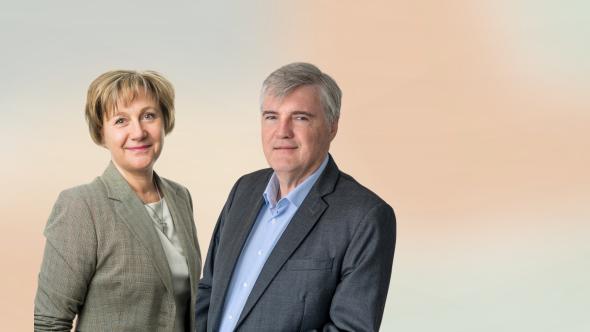
"I wanted to become an interior designer," recalls Fabienne Bister. "But at 17, an open house convinced me that it wasn't the right world for me. On my father's advice, I turned to economics and social sciences, without much conviction... Only to graduate five years later, in 1986, with honors and a burning desire to work!

Thanks to her studies at UNamur, Fabienne Bister has had several careers. She started out as a business journalist for media outlets such as L'Écho, and as a freelance writer for Femmes d'Aujourd'hui, where she wrote articles "encouraging women to be entrepreneurs." She then devoted herself to the family mustard business, Bister-L'Impériale. "I gave myself 10 years to turn the business around before considering other ventures," she recalls.

She ended up staying there for nearly three decades, developing and diversifying her business internationally. "My experience as a business leader has taught me one thing," she summarizes. I think you have to strive for excellence, but be wary of perfection. We often exhaust ourselves trying to make everything perfect. You have to accept that some departments in the company are 'good enough', i.e. good enough to function well."

Today, Fabienne Bister has sold her company to devote herself to coaching adults who are questioning their career choices, as well as mentoring student entrepreneurs through VentureLab, the start-up incubator in Liège, which she describes as "extremely successful and something to be proud of."

A career of bronze

Michel Dumont, also a graduate in economics and social sciences, left UNamur in 1984 to move to the south of France. "I was writing a thesis on the challenges of turning around struggling companies, and my studies required me to complete a six-month internship abroad," he explains. "That crucial moment completely changed the course of my life, because I was lucky enough to do that internship at a very prestigious consulting firm, which subsequently hired me."

After several years at various consulting firms, Michel Dumont decided to start his own firm, 6-24 Consulting, before buying a metallurgy company, Lebronze Industriel. "I had to devote a lot of energy to it, and although I was able to juggle both activities for a while, I eventually decided to focus on metallurgy," he says. "In 2011, I created an industrial group, Lebronze Alloys, based on this company, which is now a world leader in the creation of very high-quality copper alloys found, for example, in all aircraft worldwide and in certain watchmaking products."

While he will remain at the helm of his company for a few more years, Michel Dumont has decided to create, with his wife Carole Rasera, a philanthropic fund, the 6-24 Fund, to finance projects related to youth, heritage, biodiversity, and health. "I wanted part of this fund to finance projects in Belgium, via the King Baudouin Foundation," he explains. "And I particularly wanted to benefit UNamur, where I studied and which has given me so much. I am convinced that without this education, I would not have had such a successful career."

Back to university

When Michel Dumont and Fabienne Bister, who became president of the 6-24 fund, contacted UNamur, the university told them about the JEDDT project. They were immediately hooked. "Sustainability is a subject I am passionate about, and one in which I have been seeking to have more impact for years," says Fabienne Bister. "From the outset, I found the JEDDT project extraordinary and well designed. It just needed a little push to really take shape, which is exactly what the 6-24 fund is all about."

These days, which ultimately aim to train all third-year bachelor's students at UNamur in issues of transition and sustainable development in an interdisciplinary way by allowing them to take an interest in topics outside their curriculum, are particularly innovative. "I don't know of any other projects that leave so much room for multidisciplinarity on such a large scale," says Michel Dumont. "For me, this is very important, because I think it's essential to be open to others, especially on such a broad subject."

Fabienne Bister also emphasizes this multidisciplinary approach. "I had the privilege of attending some of the courses given during the JEDDT," she says. "And it completely shattered some of the preconceived ideas I had, such as about the creation of legislation, for example. For me, that's the essence of these days: opening your mind by working together on concrete projects in order to overcome eco-anxiety.

The 6-24 fund is set to finance the JEDDT for another two years, enabling it to reach its full potential, notably by becoming a fully-fledged teaching unit for all students. "This is one of the most wonderful projects we support within the 6-24 fund," says Michel Dumont. "But above all, I hope to inspire others to support similar initiatives within the University. One of my professors often said that in a crisis, the worst decision is to do nothing. So let's take action!"

Fabienne Bister

1981–1986: Bachelor's and Master's degrees in Economics and Social Sciences

A message to students: "Be bold, but be cautious! You have to be daring and try to turn your passions into reality, because no one else will do it for you. But be cautious nonetheless, because when you want to 'break the mold,' you often risk breaking other things without meaning to."

Michel Dumont

1979-1984: Bachelor's and Master's degrees in Economics and Social Sciences

A message to students: "I know from experience that the education you are receiving is of excellent quality and that it can take you far, both in Belgium and internationally. Have confidence in yourself and in your abilities."