The 19th century, known as the "century of inventors," was synonymous with the industrial revolution and technological and scientific advances. Universities, which until then had been mainly confined to teaching, also took advantage of the innovations of the time, particularly in communications and transportation, to open up new perspectives and become the research institutions we know today. The Notre-Dame de la Paix College, which became the Faculties and then the University of Namur, was no exception to this trend. 

Professor of botany and zoology, Jesuit Auguste Bellynck (1814-1877) was the first major figure in this evolution. He published the very first scientific research conducted at our institution, Flore de Namur (1855), posing with it in a period photograph (see photo opposite).

le jésuite Auguste Bellynck

This study, soon followed by others, earned him membership in the Royal Academy of Brussels. Father Bellynck also developed an extensive network of correspondents in Belgium and abroad, which allowed him to exchange not only ideas, but also objects and specimens that would enrich the botanical and numismatic collections of the faculties. Several hundred letters preserved at the BUMP bear witness to this intense intellectual activity. Among his contacts were the geologist Jean-Baptiste Omalius and the linguist Joseph Grandgagnage, whose names echo the toponymy of the Namur campus. Although he probably visited the Natural History Museum in Paris in 1863, the Jesuit worked mainly from Namur. International scientific mobility would not really emerge until a few decades later. 

Paris, Padua, Java: Mobility and Scholarly Exchange in the Belle Époque

At the end of the 19th century, Namur's faculties already boasted several high-profile researchers, such as physicist Désiré Lucas (1860-1949) and mycologist François Dierckx (1863-1937), both of whom were part of a vast international network spanning France, Italy, Germany, the Netherlands, and the United States. Father Lucas, who developed an interest in X-rays, whose properties were beginning to be studied, began a regular correspondence with the famous French scientist Pierre Curie (1859-1906). The future Nobel Prize winner sent him several samples of barium and thanked his correspondent "for making the results of [his] research known in Belgium" (1901). 

The career of Father Dierckx (photo opposite) reflects the growing internationalization of scientific life during the same period. Author of a notable study on penicillium fungi, he obtained a grant from the Belgian government to continue his research at the botanical garden in Buitenzorg (Bogor) in Indonesia, then a Dutch colony. 

père Dierckx

He undertook a long journey in 1901-1902, which took him to Italy (Padua, Messina), where he met several colleagues, before traveling to the Suez Canal, Sri Lanka, and then the island of Java. Travel conditions were still difficult, and upon his arrival in Java, the researcher sadly discovered that all of his precious mushroom specimens had died during the crossing. The trip proved to be rich in human and scientific discoveries: Buitenzorg was then one of the most renowned institutions in the world, particularly because of its exceptional collection of tropical flora (see image above). Back in Belgium, the researcher organized numerous conferences on the society and natural curiosities of Indonesia and Italy, particularly the volcanoes and seismic phenomena that had piqued his curiosity. The press regularly reported on these events, which were accompanied by impressive "panoramic light projections" of photographs taken by the Jesuit from Namur. 

Initial international scientific research

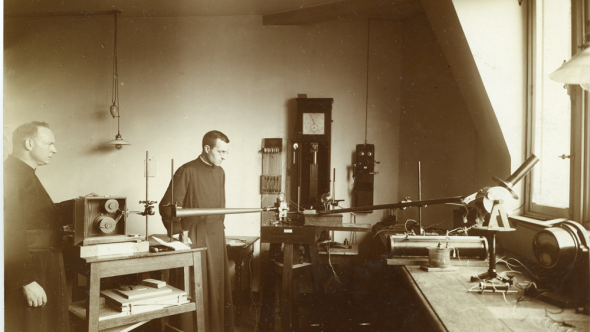
It was during this same period that large-scale international research projects began to develop in Namur. During the solar eclipse of April 17, 1912, the university's astronomical observatory, directed by Désiré Lucas, welcomed a team of Belgian and foreign physicists. The team included Theodor Wulf (1868-1946) from Germany, whose research on atmospheric radiation was highly innovative, and José Mier y Terán (1878-1942), a Jesuit of Mexican origin and director of the observatory in Granada, Spain. The researchers had access to a state-of-the-art wireless telegraphy receiver, directly connected to the Eiffel Tower in Paris, which enabled them to determine the exact time corresponding to the data collected. 

Their experiences are immortalized in a remarkable series of photographs, one of which shows Father Lucas (left) and Father Wulf (right) standing next to the equipment they had specially assembled for the occasion (see photo opposite). The results obtained will be published a few months later.

photo d'archive de la BUMP

The following decades saw the continuation of a process that was now well underway and which has not stopped since, facilitated by the democratization of transportation and communication. Today, our scientists are part of several international networks, spending time at prestigious institutions on every continent, where they promote the excellence of Namur's research. UNamur also welcomes many foreign researchers to its laboratories, with 11% of academics and 22% of scientists coming from abroad. 

Browse Professor Désiré Lucas' correspondence with, notably, Nobel Prize winner Pierre Curie.

The heritage collections of UNamur offer valuable insight into the development of scientific practices and, more broadly, into the process of knowledge construction in the 19th and 20th centuries. Many of the documents recounting this fascinating history are now freely accessible on the BUMP digitization portal: https://neptun.unamur.be/

Cet article est tiré de la rubrique "Le jour où" du magazine Omalius #38 (Septembre 2025).

cover-omalius-septembre-2025