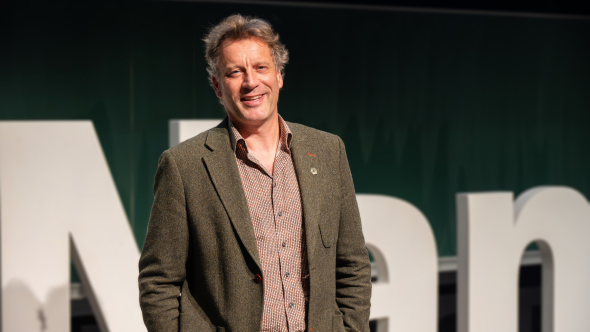
How did your passion for cosmology begin? Was there a specific moment that sparked it?

The real turning point was my meeting with Stephen Hawking. At the time, I was already curious about the big philosophical questions. I loved reading the great philosophers. When I met Hawking, I discovered that there is a discipline called fundamental cosmology, which scientifically addresses the big eternal questions that all humans ask themselves: Where do we come from? What is our place in the universe? Are we alone? Hawking was the first scientist I met who explored these questions using rigorous scientific methodology. I was immediately fascinated.

In your book The Origin of Time, which explores Stephen Hawking's latest theory, you revisit the beginnings of the universe since the Big Bang. What do we know about it today?

We already know a lot. We are familiar with the processes that led to the formation of particles, atoms, molecules, stars, and planets. It is the more fundamental questions that still elude us: Where did space come from? How is it that the universe seems designed for life to appear in it? Is the Big Bang the beginning of time? These are existential questions that remain unanswered and require a deeper understanding. I think Hawking wanted to better understand the beginning of the universe, but also to comprehend the unity of nature and the link between our existence and the way the universe works. He was enormously optimistic about science's ability to shed light on this phenomenon. 

What is the theory that you developed with Stephen Hawking?

According to our hypothesis, the Big Bang is not just the beginning of the universe: it is the origin of time and physical laws. When we go back in the history of the universe, we realize that the laws of physics disappear. After years of research, we have arrived at a rather Darwinian view of this primordial phase of the universe, where even the laws of physics evolved.

Does this theory contradict what we already knew?

Yes, absolutely. Physics has always sought the ultimate theory. We propose an epistemological readjustment: instead of a fundamental basis founded on fixed and eternal laws, we have arrived at a conception of physics based on the idea of emergent laws, as in biology. For us, the Big Bang becomes a kind of epistemological horizon; it is a new vision of the world. 

What cosmological questions still preoccupy you?

Now we need to test this theory. This phase of the universe's evolution is difficult to access because, in its early days, the universe was opaque. We cannot directly observe the Big Bang before what is known as the "cosmic microwave background," light emitted approximately 380,000 years after the Big Bang. Currently, we are witnessing a revolution in astronomy around the observation of gravitational waves, generated by the collision of black holes, which we can now detect. These sources of information, which travel through space without being altered, could one day open a window onto the very beginnings of the world, before light.

How did your collaboration with Stephen Hawking shape your vision of the research profession?

I worked with Stephen Hawking for twenty years. It was an extremely rewarding collaboration. He played a major role in my training. The magic of physics and cosmology lies in finding the right balance between mathematical abstraction, philosophical clarity, and observations. Stephen Hawking had a unique talent for striking that balance, and his vision has inspired my research.

Your book is an attempt to popularize science. You also participate in conferences aimed at the general public. Why do you think this is important?

I don't see popularization as simply passing on knowledge, but as a means of strengthening scientific culture. I think it's essential to maintain critical debate based on facts and rational data, which are the pillars of the scientific method. This scientific culture can never be taken for granted; it remains fragile, especially in the context of widespread misinformation. Cultivating it means allowing everyone to take part in the collective debate on the future we want.

BIO express  

Thomas Hertog studied physics at KU Leuven. He met Stephen Hawking during his second master's degree at the University of Cambridge, where he went on to earn a doctorate. He then worked as a researcher at the University of California (Santa Barbara) and CERN (Geneva). Thomas Hertog is now a professor at KU Leuven and director of the Leuven Gravity Institute, a multidisciplinary research center on gravitational waves.

Grandes Conférences Namuroises (GCN): an invitation to curiosity

Come listen and share ideas with some of the leading figures in our society who encourage us to reflect and open ourselves up to the world: this is the invitation that the GCN has been extending to the public every year for more than ten years. This series of conferences, organized by the University of Namur in partnership with the Point-Virgule bookstore and the Théâtre de Namur, examines major societal issues: the environment, economics, culture, philosophy, literature, science, and digital technology.

Présentation Grande Conférence Namuroise Thomas Hertog

This article is taken from the "Guest" section of Omalius magazine #39 (December 2025).


Cover Omalius décembre 2025