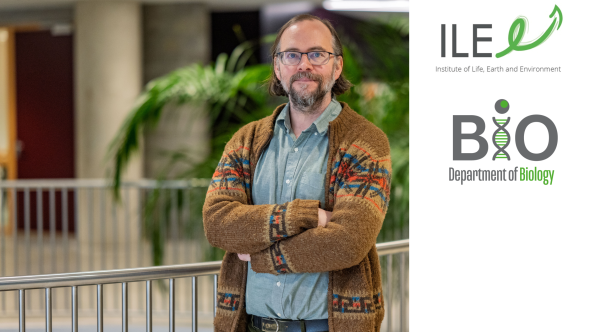
Brendan Reid comes from New Jersey, USA.  He was appointed Professor of Biology at the University of Namur in September 2025 and became a member of the Institute of Life, Earth and Environment (ILEE).  His research focusses on changes in aquatic and semi aquatic organisms and communities. He is particularly interested in fish and herps.  To carry out his research, he uses (meta)genomics and field research, as well as demographic and genomic data.  The goal? The preservation and management of diversity.

Sustainable conservation solutions

Brendan Reid's research combines cutting-edge genomic sequencing in space and time with habitat and demographic data, and computational methods.  The aim is to understand the evolutionary responses of species and communities to environmental change over time and to propose conservation solutions to ensure their sustainability. He is particularly interested in using genetics and museum collections to understand the basis of species responses to new stresses and to preserve biodiversity in the current era of global climate change.

In a mid-January seminar, Brendan Reid presented his research to his new colleagues: the members of the ILEE Institute and members of the Department of Biology, URBE.

Research questions

How can genetics teach us about biological diversity? 

He carried out a postdoc research project about the genetic barcoding and identification of marine and freshwater turtles.  Another research project enabled him to analyse environmental DNA to assess different communities in highly human-impacted environments: reef monitoring, rivers in urban environments.

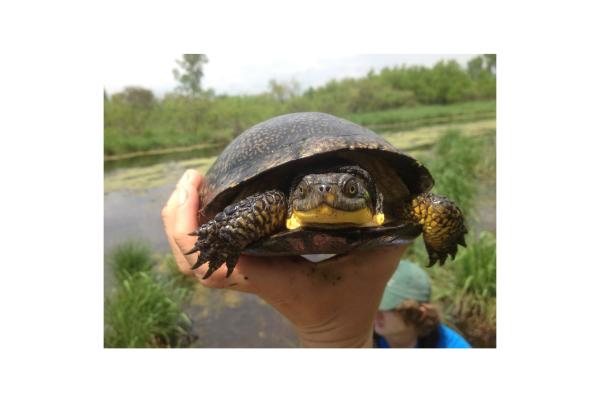
A Blanding’s turtle (Emydoidea blandingii) from one of Brendan Reid's study populations in Wisconsin © Brendan Reid

Photo: A Blanding's turtle (Emydoidea blandingii) from one of the populations studied in Wisconsin © Brendan Reid 

How does loss of genetic diversity and inbreeding affect small populations?

He investigated this question in 2 postdoc research projects: one about the genetics of freshwater fish and another one about the inbreeding and fitness in endangered rattlesnakes.

How do populations respond to increasing human impact over time?

His PhD was about turtles and roads.  There is still ongoing work on turtles thanks to a USFWS grant.  He is currently leading a large-scale project to create a genomic database for the endangered Blanding's turtle, which will be used in USA conservation planning and forensics.

Historical genomics to answer questions

Postdoc research was carried out on historical genomics of fish to investigate how genetical diversity has changed over time. The “fisheries-induced evolution in cod project” used historic and contemporary samples from Norway and from Newfoundland, Canada. 

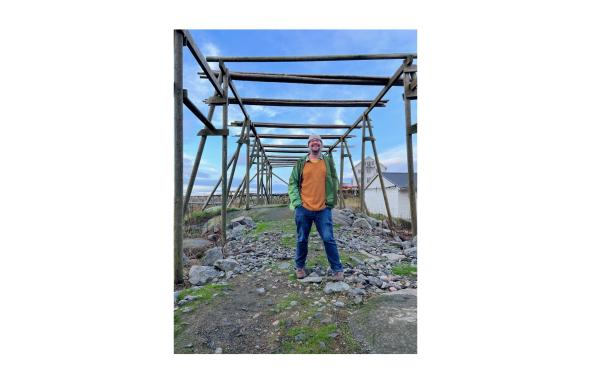
Brendan Reid dans les îles Lofoten, en Norvège, avec des séchoirs utilisés dans la pêche norvégienne à la morue - l'un des d'étude dans laquelle les chercheurs ont utilisé des échantillons de 1907 associés à des échantillons des années 2010 afin de comprendre comment la morue s'est adaptée à la surpêche.  © Patrice Escandon

Photo: Brendan Reid in the Lofoten Islands, Norway, with drying racks used in Norwegian cod fishing—one of the studies in which researchers used samples from 1907 paired with samples from the 2010s to understand how cod have adapted to overfishing. © Patrice Escandon

Image
Brendan Reid

The evolutionary changes in size and age at maturity were already known, but we were interested in whether they were oligogenic (caused by changes in just a few genes) or polygenic (caused by changes in many genes with small individual effects). We showed that it was most likely polygenic evolution, not oligogenic evolution, that was behind the fisheries-induced changes.  One of the achievements that he has been most proud of has been publishing this study in Philosophical Transactions of the Royal Society - the world’s oldest scientific journal!

Brendan Reid Professor in the Department of Biology, URBE, and member of the ILEE Institute

The article “Detecting parallel polygenic adaptation to novel evolutionary pressure in wild populations: a case study in Atlantic cod (Gadus morhua)” is available in open access.

For historical samples, this was made possible in particular through the ARC Albatros recollection project (in the Philippines) refers to the USS Albatros expedition in 1908-1909, which brought back a huge collection of specimens conserved in ethanol (high powered rum 😊), not formalin.  More than 10.000 specimens were paired with contemporary sampling taken from 60 sites between 2017 and 2022. 

The ongoing PIRE project in the Philippines investigates changes in tropical (not temperate) regions, though a main goal is to determine whether the trends are similar across different climatic zones.  It links museum specimens collected in the early 1900s to contemporary populations to understand how habitat changes have influenced the neutral and adaptive genetic diversity of fish.

Proven losses in diversity

All of this research has led to the general conclusion that insect, bird, mammal, and fish populations have declined and lost between 6% and 16% of their diversity to date. Genomics confirms a recent collapse in populations, probably linked to habitat change caused by human activity. There has also been a 4% loss of diversity in areas with high human density, and stronger selection in areas of greater development. Finally, tropical fish are losing their genetic diversity overall.

Future research projects at UNamur

Among the projects Brendan hopes to develop is research at the Domaine d'Haugimont on habitat management and monitoring of endangered Belgian amphibians. He says he is eager to start working on environmental DNA and certain salamander monitoring projects in the near future, including a project with SPW Research.  Haugimont is recognized as a Site of Great Biological Interest (SGIB) by the Walloon Region.

Logo du domaine d'HAugimont de l'UNamur

Brendan would also like to look into historical genomics (mainly in insects) to identify signs of change and adaptation in communities based on data collected from specimens.

And work on the renaturation of Europe in general, mainly rivers and canals.

The importance of conservation

Brendan would like to determine species conservation needs and issues by analyzing breeding programs in zoos. He also wants to continue genetic analysis of populations and collect data in the field in order to maintain consistency between theory and practice and, above all, to accurately target the species most in need of protection. 

Image
Brendan Reid

I chose to join UNamur because I do a lot of work with aquatic or semi-aquatic organisms that combined molecular techniques and ecological data, and research profiles of the other members of URBE were all quite interesting to me - I could see a lot of possible collaborations and intersections. I had also worked quite a bit on long-term monitoring projects in nature reserves, and I was interested in developing the UNamur research at the Domaine d’Haugimont.

Aside from the fieldwork (which is what most conservation biologists live for) I really like working with students and developing ideas for research projects.

I am looking forward to getting started on environmental DNA work and some salamander monitoring projects in the near future.

Brendan Reid Professor in the Department of Biology, URBE, and member of the ILEE Institute

Brendan Reid - Mini CV

Brendan is originally from the United States, born in the state of New Jersey. He lived in New York for years before recently moving to Belgium. He earned a bachelor's degree in biology and English from Williams College, a master's degree in conservation biology from Columbia University, and a PhD in wildlife ecology from the University of Wisconsin-Madison. After completing his PhD (and before joining UNamur), he conducted postdoctoral research at the American Museum of Natural History, Michigan State University, Rutgers University, and the University of California, Santa Cruz.

Prof. Brendan Reid

Given his wealth of research, cutting-edge expertise, and motivation, it is no surprise that Brendan Reid was chosen to join the URBE team in the Department of Biology.

Welcome, Brendan! 

Institute of Life, Earth, and Environment (ILEE)

The ILEE Institute is dedicated to advancing fundamental and applied research to better understand the underlying processes that regulate life on Earth, to characterize anthropogenic pressures on the environment and vice versa, and to seek sustainable alternatives for managing natural resources, reducing pollution, and conserving and restoring biodiversity. 

Logo institut de recherche ilee