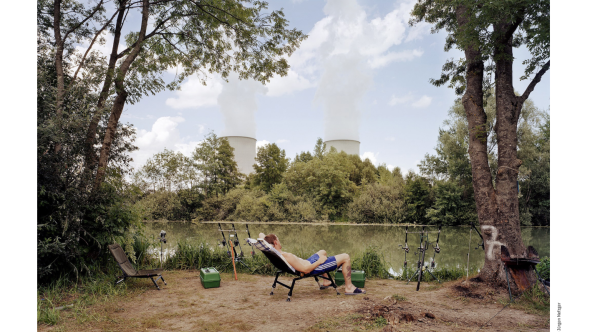
While the extension of the Tihange and Doel power plants has drawn little reaction, Danielle Leenaerts’ research project uses art to reignite the discussion in a novel way. This project is unique in that it explores representations of civil and military nuclear energy across various media that engage in dialogue with one another, namely: a photo exhibition at the Delta, a book, and a study day. Her work brings together the perspectives of artists with diverse viewpoints and rejects the polarization of the debate. The goal is rather to encourage society to face a reality it strives to conceal. This approach demonstrates that culture and research are essential tools for addressing today’s geopolitical and environmental challenges. Interview.

How did this research project on how photographers depict nuclear power come about?

This project runs parallel to my teaching of contemporary art history. As part of this, I received an FNRS–PDR research grant, which provided a broader foundation for the project. This allowed me to structure it in three parts: an exhibition, a book, and a study day.  

I am interested in nuclear energy because this theme encapsulates the core political, geopolitical, and human issues of the past 75 years. On the one hand, with the invention of the atomic bomb, regarding military nuclear power, and on the other hand, with the exponential growth in the use of civil nuclear power for energy production. According to the philosopher Günther Anders, we have in fact entered the “atomic age” with the constant risk of “globocide”—that is, the possibility of destroying all life on the Earth’s surface. And we are fully aware of this reality when it comes to military nuclear power. But humans are also in denial about the risks inherent in the use of civil nuclear power, as the Fukushima disaster recently demonstrated. This is a true cognitive dissonance because we know the risks and the duration of the potential fallout, yet we do not react. Worse still, our energy consumption is skyrocketing, as civil nuclear power is presented as the primary solution to decarbonization. A solution that sidesteps the issues of risk and the management of nuclear waste, whose half-life spans several centuries or tens of millennia. These absolutely essential questions must be discussed by civil society but are not. This is also what I aim to achieve with this research project: to enable a public debate on the issue of nuclear power, because it concerns us all and will have an impact on our future. 

Why did you choose photography? In your opinion, what does it offer that other mediums don’t?

Photography was already the subject of my dissertation, so this issue has been on my mind for a long time. It is my primary area of focus in both teaching and research. Indeed, photography has long been conspicuously absent from art history research, which has traditionally focused primarily on the fine arts in the broadest sense. For me, it was also important to introduce this type of representation into the academic field, particularly in the history of contemporary art. Along the way, I became aware of a whole series of works dealing with nuclear energy, and I saw them as an attempt to bring these issues to light. These artists’ works allow us to engage with questions that are not addressed in the media or are addressed in a simplified, even polarizing manner. 

I also wanted to avoid anything fictional regarding the nuclear issue. Photography serves as documentary evidence, yet at the same time, it offers a representation that speaks to the world through an aesthetic medium that invites us to pause and reflect. Photography is an art form that allows us to associate images with concepts and to humanize the nuclear issue. 

Nuclear energy is at the center of current events, amid climate concerns, aging infrastructure, and geopolitical tensions. How does this news shape the reception of these works?

Currently, the government has decided not to phase out nuclear power and has extended the operating life of the Tihange and Doel plants. I am very surprised by the lack of reaction from civil society on this issue. Decarbonization is, of course, necessary, but nuclear power is not the only solution. Moreover, it is a solution that poses numerous risks and is highly polluting. We’re talking about radioactive waste that will remain radioactive for thousands of years. This projects us into time frames that are unimaginable. It is one of the major challenges in how the public will receive the exhibition. I hope this exhibition will help identify the issues and risks while there is still time to change things. I am therefore very curious to see how the public will react and am very grateful to the Delta for hosting the exhibition project. The Delta and Confluent des Savoirs have also worked to make the information accessible to the general public in order to communicate our knowledge about nuclear power more effectively. This information provides a framework for the exhibition, but the interpretation of the works remains entirely up to the public. Everyone is free to interpret them as they wish. In any case, I hope this exhibition will prompt the public to ask questions and spark a debate.

How did you select the ten Belgian and international artists on whom your work is based?

Starting with the Belgian context and an artist, Cécile Massart, who for 30 years has dedicated herself to the issue of civil nuclear power and waste management—and more specifically to raising awareness of storage sites. Cécile Massart has created markers for underground storage sites. Her pioneering work raised my awareness of nuclear issues. I also came across the work of a young photographer who focused on Tihange for his graduation project. A Belgian focus therefore made sense. Then, my interest in nuclear accidents led me to other photographers, such as Anaïs Tondeur. Finally, I became interested in military nuclear power, and other photographers came to the forefront. Ultimately, the ten selected photographers offer a diverse representation of the nuclear chain (waste, material processing, decommissioning, activist occupation, etc.) and both civilian and military issues. 

The photo exhibition isn’t the only medium you’re using to present your research. You’re also publishing a book, titled after the exhibition, and organizing a study day. How does the book complement or extend the exhibition experience?

The book, *(Faire) face au nucléaire*, which will be released in late March, and the exhibition are two separate mediums. The book is not a catalog of the exhibition. It features most of the artists but not necessarily the works on display. The book allows for a deeper analysis and contextualizes the understanding of nuclear power in relation to the artworks. It also explores the aesthetics of the works in greater depth. The data presented in the book is also more detailed and precise than that featured in the exhibition. The book outlines the results of in-depth research. But I want to clarify that the book’s focus is art history, not physics. It does, however, help readers grasp the general context, key elements, and major issues surrounding nuclear energy. 

The book also helps readers understand the artists’ positions on the nuclear issue. Some are anti-nuclear, while others take a more nuanced stance. The book thus presents a full spectrum of viewpoints on the issue. I hope it will also foster public debate and move beyond the polarized “for” or “against” positions on nuclear power. The book aims to reintroduce factual information into the debate, rather than opinions, and to refocus attention on the question of life. It seeks to offer knowledge and nuance. 

After two years of research, what is your current perspective on how art can contribute to our understanding of nuclear energy?

I am more convinced than ever that this is a healthy space for expression. These works give concrete form to the abstract. Photography is a powerful artistic medium that has fostered an interest in these issues. Art allows for an unprecedented space of freedom. But the scope of artistic expression still needs to be defended. My research is also significant from this perspective. It shows that artistic expression is possible even when culture faces budget cuts. 

Does this research pave the way for new projects?

I’m not sure yet. Bringing this project to fruition was a major challenge. I’ll continue to support the project and share it through other formats and channels (lectures, videos, etc.) to keep it alive. In the near future, I hope to continue exploring contemporary art in French-speaking Belgium and to keep engaging with social issues.

“Facing Nuclear Power: The Exhibition”

March 28–August 2, 2026

Admission: €10 > €5

The exhibition is open from 11 a.m. to 6 p.m. Tuesday through Friday and from 10 a.m. to 6 p.m. on Saturdays and Sundays.

For all ages

Related events:

“Facing Nuclear Power: The Book”

Coming out in late March

La Lettre Volée Publishing

€25

Special Feature: “Confronting Nuclear Power: The Study Day”

Friday, March 27, from 9:30 a.m. to 5:30 p.m.

At the B&LC (5 Rue Godefroid, Namur)

The morning will be devoted to nuclear power as viewed through the lens of the natural sciences and the humanities. The afternoon will feature presentations by artists.

“Facing Nuclear Power: The Book”

Coming out in late March

La Lettre Volée Publishing

€25

Special Feature: “Confronting Nuclear Power: The Study Day”

Friday, March 27, from 9:30 a.m. to 5:30 p.m.

At the B&LC (5 Rue Godefroid, Namur)

The morning will be devoted to nuclear power as viewed through the lens of the natural sciences and the humanities. The afternoon will feature presentations by artists.