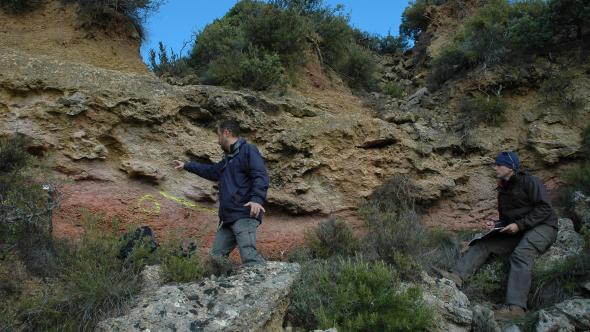
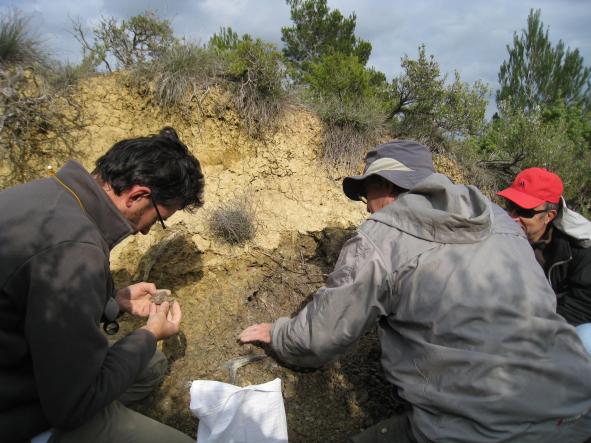
Photo: Excavation site at Albas, Massif des Corbières (France) © Gaëtan Rochez (UNamur)

Current predictions for biodiversity evolution in the face of climate change are based on models and scenarios derived from multidisciplinary studies. An article has just been published in the prestigious journal PNAS (Proceedings of the National Academy of Sciences), feeding into these scenarios. The researchers' original idea? To envisage an analogy between the biodiversity of the past and that of the future.

To understand, we need to go back 56 million years, to the transition between the Paleocene and the Eocene, a period characterized by intense global warming (named Paleocene-Eocene Thermal Maximum - or PETM). Paleoclimatologists consider this period to be a geological analogue of today's warming in terms of its amplitude (an increase of 5 to 8°C) and cause (a massive release of CO₂ into the atmosphere, similar to what we experience today).

At this time, global warming generated major disturbances on fauna. This change in climate, although 10 to 100 times slower than the one we experience today, coincided with the appearance of "modern" placental mammals (of which humans are a part), but also artiodactyls (ruminants, goats...), perissodactyls (horses, rhinoceroses...), bats, rodents and so on. Intense and rapid climatic disturbances generate major stresses on ecosystems: organisms try to adapt, some disappearing because they are unable to cope with these intense environmental changes, while others develop or evolve. This scenario was already well known...

But a few thousand years before PETM, another warming episode, named Pre-Onset Event (or POE), is recorded. It is less intense (+2°C) than the PETM, and more similar to current climate disturbances, leading researchers to investigate its impacts on faunas.

Johan Yans à Albas

Fossils speak

Field research has been carried out in the Massif des Corbières, southern France: the geological layers representative of this period are numerous and thick. Thanks to carbon isotope geochemistry, Namur researchers have been able to date these layers with great precision, making it possible to detail the evolution of fossils over time.

The fossils thus discovered have delivered their memory. And this calls into question previously established scenarios in two key respects:

  • Species evolved rapidly as early as the EOP, a climatic event similar to today's disturbances.
  • While researchers thought that European faunas were made up of endemic species confined to Europe, they discovered that these archaic animals also rubbed shoulders with more modern species, such as marsupials or rodents, having probably migrated from North America during the EOP.
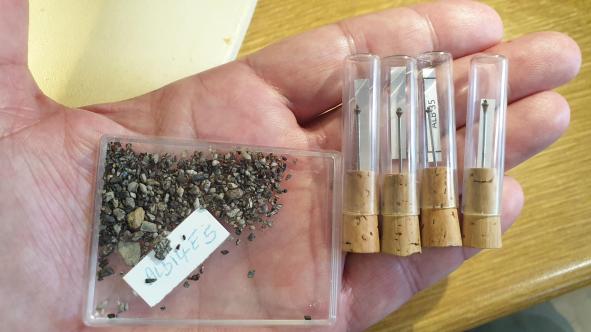
Echantillons de fossiles prélevés en cours de fouilles, Albas, France

Photo: Mammal fossils discovered at Albas preserved in small glass tubes. These are the tiny teeth of a small "archaic" mammal called Paschatherium. Rodolphe Tabuce

So, during the EOP, species migrated from one continent to another... But how is this possible? It was thought that, at the time, the European continent was relatively isolated from the others by shallow seas. In reality, as a result of global warming, vast expanses of forest covered the high latitudes (present-day northern Greenland, Scandinavia and the Bering Strait in Siberia), serving as "natural land bridges" for forest fauna! Climatic disturbances therefore modified the flora, which in turn served as a passage between continents for "modern" faunas, also in the midst of upheaval.

The climatic disturbances of the POE, similar to those recorded today, therefore drastically influenced the faunas, notably by facilitating intercontinental migrations.

The impact of these decisive events during the EOP offers new avenues for reflection and study on the future of biodiversity in the context of current and future global warming.

The project team

"EDENs: Life during past super-warm climate events: Evolutionary Dynamics of Early EoceNe mammals from Southwestern France" is a multidisciplinary and international project in which Johan Yans, Jean-Yves Storme and Gaëtan Rochez (Geology Department and ILEE Institute) have been participating for the past 3 years. This research brings together the expertise of various partners:

  • L'Institut des Sciences de l'Evolution de Montpellier (ISEM), Rodolphe Tabuce and Fabrice Lihoreau,
  • Géosciences Montpellier, Flavia Girard and Gregory Ballas.

It is funded by the French National Research Agency (ANR-France). Its mission is to support and promote the development of fundamental and finalized research in all disciplines, and to strengthen the dialogue between science and society.

Sustainable development at UNamur

The university, in its missions, must be exemplary in terms of Sustainable Development in line with the United Nations Sustainable Development Goals (SDGs).

Objectifs du développement durable

In terms of training, in addition to courses incorporating the SDOs, the University of Namur offers the University Certificate of Further Training in Sustainable Development. Aimed at members of organizations, administrations, companies, schools, etc. concerned or simply interested in the implications and challenges of sustainable development, it aims to offer information that is as thoughtful and diversified as possible, in order to help each participant better position, in his or her professional context, the issues linked to sustainable development that concern him or her more directly.

In terms of research, researchers work through 11 interdisciplinary research institutes. Johan Yans' team is active within the Institute ILEE - Institute of Life, Earth and Environment - and this research is a focus of activities devoted to Sustainable Development at UNamur.