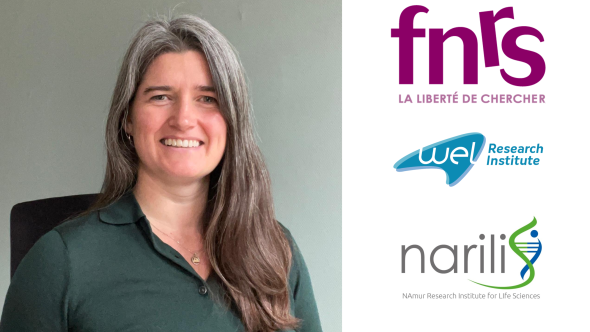
Alison Forrester is also a member of the Faculty of Science, Department of Biology (URBC), a member of the NARILIS Research Institute, a researcher at the Namur Research College (NARC), and an investigator at the WEL Research Institute.

The importance of protein trafficking in cellular health

The mammalian body is made up of proteins, lipids and water, with proteins making up 42 % of the total dry mass of a human body. Therefore, protein synthesis is a key process for the body. The biosynthetic pathway begins with amino acid chains in the Endoplasmic Reticulum (ER). They are modified, folded and then packaged into transport carriers at the ER Exit Site (ERES), transporting them to the Golgi for further modification. From there they are packaged into post-Golgi carriers to deliver the fully folded proteins to their destination, either inside the cell, or to the plasma membrane where they remain, or they are secreted into the extracellular space. Thus, efficient protein synthesis and transport is a key process to maintain homeostasis. 

When it is lost, it can cause many common and varied diseases.  The process is highly regulated to quickly meet the needs of the cell and the body, for example, increase in secretion of insulin in response to glucose, or increase in collagen secretion during postnatal growth, and also to ensure that no improperly made proteins are distributed throughout the cell. 

When this goes wrong, it can be the cause of diseases such as fibrosis which is caused by excessive protein production, or osteogenesis imperfecta which is caused by a mutation in one of the ERES proteins. 

Alison’s research group studies how different compounds can be used to modify the efficiency of the protein trafficking process, and how this will affect the normal balance within the cell. 

A bit of biology

This roadmap article provides a total view of Endoplasmic Reticulum (ER) exit sites (ERES), specialized subdomains of the ER where folded proteins are selected and packaged into membrane-bound carriers that transport the nascent proteins on the first main step of their journey to be secreted. The discovery of ERES is not new, and the foundational discoveries of protein and lipid trafficking were awarded the Nobel prize in 2013. However, new technologies now allow us to revisit the original hypotheses, as well as to drive the field further than ever before. This renaissance has uncovered new exciting areas in this field that are discussed in this roadmap article, including how ERES are actually organised, how they can adapt their function to other known physiological roles such as autophagy and lipid droplet formation, and how the process of protein recruitment and trafficking can be regulated pharmacologically. It is the latter question that Alison Forrester is interested in addressing. 

Protein trafficking dysfunction, including misfolding or aggregation, excessive or decreased protein transport, and the stress responses linked to these dysfunctions are at the heart of many cellular pathologies, ranging from neurodegenerative diseases (Alzheimer's or Parkinson's diseases), where the accumulation of toxic proteins disrupts neuronal function and kills cells; cancer, affecting cell division, migration and survival; to protein transport disorders arising from mutations in the cargo, such as cystic fibrosis. These alterations lead to an overload of quality control systems (including ER-stress and autophagy) and serious pathologies, highlighting the importance of protein transport for cellular health.

Cutting-edge technologies

In the article, published in Nature Reviews Molecular Cell Biology, the researchers propose a multidisciplinary framework — leveraging advances in the recent progress in certain technologies including high and super-resolution imaging, synthetic reconstitution and computational modelling — to delineate the principles governing the function and plasticity of ERES. Here, the University of Namur is well positioned to provide the tools needed by Dr Forrester’s team. 

The Morphology and Imaging Platform (Morph-IM) – Optical Microscopy

This platform is home to cutting edge microscopes that her team uses in these studies. Medium throughput confocal microscopes allow Dr Forrester’s team to screen compounds to identify their effect on the secretory pathway. 4-dimensional high-speed imaging using the Lattice light-sheet microscope will allow her team to track 3D movement of cargo proteins through the whole cell volume at 2 second intervals, and super-resolution live cell imaging will allow to identify which proteins are involved at single ERES during different states of ER exit and for different cargo. 

This holds significant potential for developing targeted therapeutic strategies in diseases linked to trafficking dysfunction.

Analyse au microscope

Alison obtained an F.R.S.-FNRS position as a Qualified Researcher (CQ) at the University of Namur, Department of Biology (URBC), and became a member of the NARILIS Institute in October 2022. 

Alison Forrester | Express CV

Alison Forrester did her BSc in Pharmacology and PhD in Toxicology and Dermatology at the University of Newcastle, UK. Interested in autophagy and disease formation, she took a Postdoc position in Carmine Settembre’s lab at the Telethon Institute of Genetics and Medicine (TIGEM) in Naples, Italy then moved to Ludger Johannes’ lab at the Institute Curie in Paris, France.


Photo d'Alison Forrester
Photo: Alison Forrester

Since completing her PhD, she has built her expertise in advanced imaging techniques including confocal and high-resolution microscopy, live cell imaging, notably including Lattice Light-sheet microscopy, and electron microscopy).

She works in a highly collaborative and interdisciplinary environment, combining cell biology, chemical biology, advanced microscopy and image analysis to build fundamental projects that will develop into translation research.

Alison is passionate about creative, cutting-edge research without boundaries, working in multidisciplinary and collaborative environments. She is also passionate about sharing her enthusiasm for research and providing first-hand experiences to people through outreach initiatives and collaborations, seminars and conferences to the scientific community. 

Alison Forrester et son groupe de recherche 2026
Photo: Alison Forrester and her research group

Alison Forrester organizes a monthly microscopy communitymeeting, open to all light microscopy users at the University of Namur and organises a number of prestigious international conferences, including the FEBS-EMBO Advanced Lecture course on membranes and their lipids and proteins in organelle biogenesis, which will be held on the Greek island of Spetses in May 2026.

Biology studies at UNamur

The Department of Biology at UNamur offers cutting-edge, modern, diverse, and internationally oriented scientific training. It offers bachelor's degrees as well as master's degrees with in-depth or specialized focus areas, as well as master's degrees in biology education. It is also possible to continue your education with a doctorate in one of the research units.