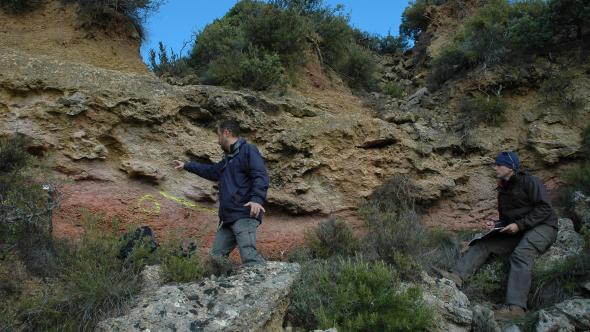
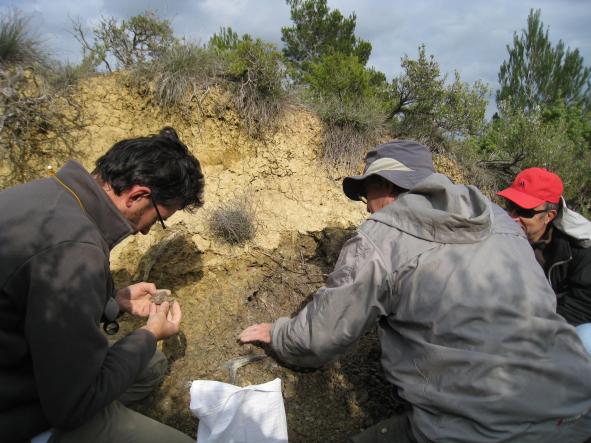
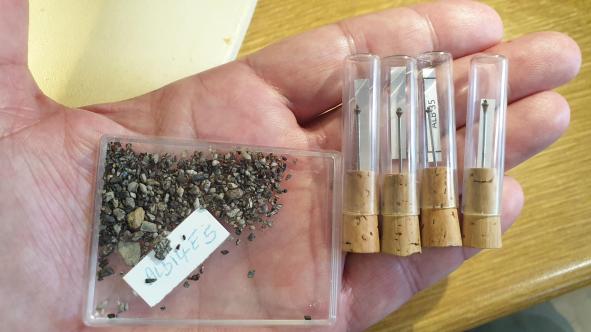
Photo: Excavation site at Albas, Massif des Corbières (France) © Gaëtan Rochez (UNamur)
Current predictions for biodiversity evolution in the face of climate change are based on models and scenarios derived from multidisciplinary studies. An article has just been published in the prestigious journal PNAS (Proceedings of the National Academy of Sciences), feeding into these scenarios. The researchers' original idea? To envisage an analogy between the biodiversity of the past and that of the future.
To understand, we need to go back 56 million years, to the transition between the Paleocene and the Eocene, a period characterized by intense global warming (named Paleocene-Eocene Thermal Maximum - or PETM). Paleoclimatologists consider this period to be a geological analogue of today's warming in terms of its amplitude (an increase of 5 to 8°C) and cause (a massive release of CO₂ into the atmosphere, similar to what we experience today).
At this time, global warming generated major disturbances on fauna. This change in climate, although 10 to 100 times slower than the one we experience today, coincided with the appearance of "modern" placental mammals (of which humans are a part), but also artiodactyls (ruminants, goats...), perissodactyls (horses, rhinoceroses...), bats, rodents and so on. Intense and rapid climatic disturbances generate major stresses on ecosystems: organisms try to adapt, some disappearing because they are unable to cope with these intense environmental changes, while others develop or evolve. This scenario was already well known...
But a few thousand years before PETM, another warming episode, named Pre-Onset Event (or POE), is recorded. It is less intense (+2°C) than the PETM, and more similar to current climate disturbances, leading researchers to investigate its impacts on faunas.